

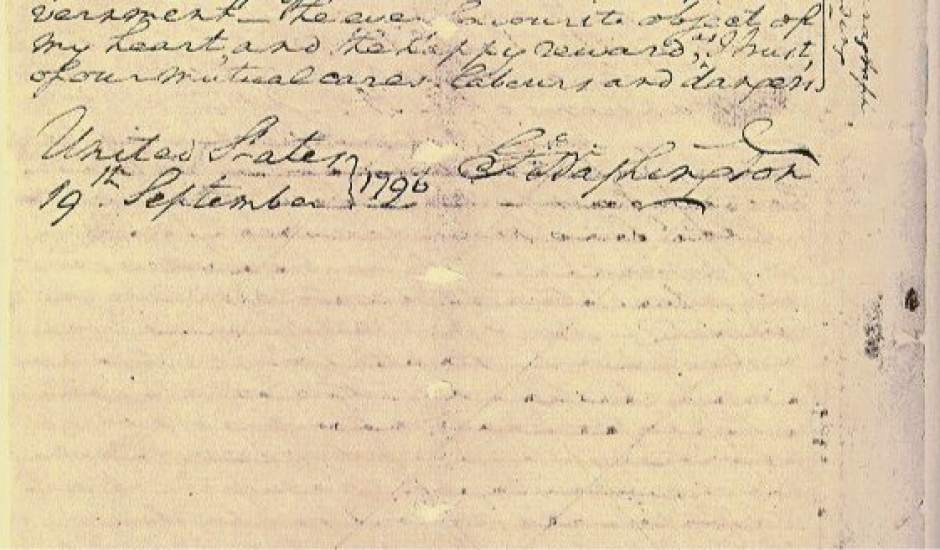
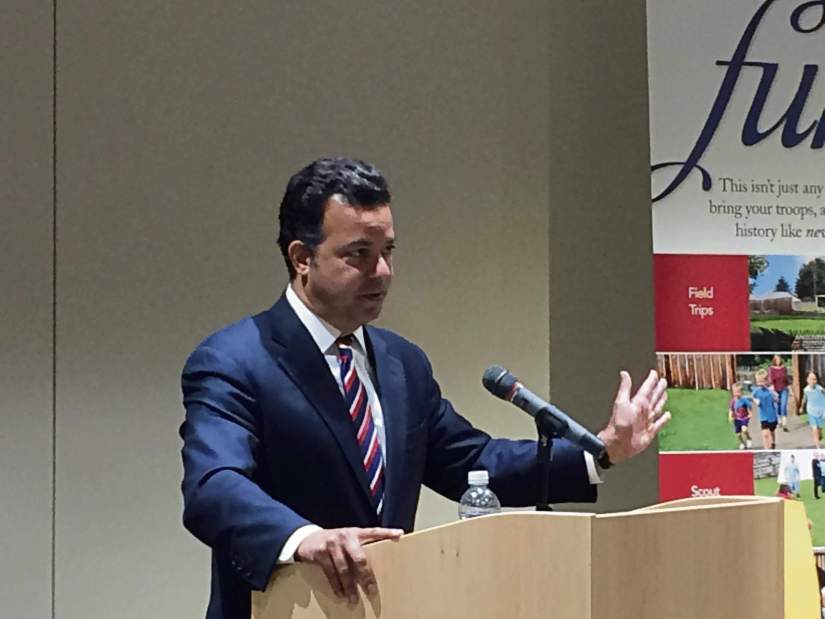
The country's political leaders — including President Trump and Congress — would do well to heed George Washington's warnings against hyper-partisanship, excessive debt, wars and entangling alliances, said author John Avlon, editor of The Daily Beast and a CNN political commentator.
“It seemed so relevant. It is this amazing, almost forgotten wisdom about the dangers of hyper-partisanship, combating polarization,” said Avlon, author of “Washington's Farewell: The Founding Father's Warning to Future Generations.”
The 6,088-word Farewell Address , which Washington published in 1796 as his second presidential term was ending, is the kind of document “that can provide common ground and common purpose,” Avlon said.
“It is the autobiography of Washington's ideas,” said Avlon, who spoke this week at the Fort Ligonier Center for History Education.
About 125 people attended the event Thursday night.
The primary force that Washington worried could destroy the fledging democracy was hyper-partisanship and polarization, Avlon said. The first president understood that independence as a nation was inseparable from our interdependence as a people, Avlon said.
Washington warned against those he called “pretend patriots,” who would divide the country by claiming to be “better Americans,” representing one faction, Avlon said. He was deeply concerned that political hyper-partisanship would deadlock democracy. That creates frustration among citizens about the inefficiency and ineffectiveness of government and “opens the door to a demagogue with authoritarian ambitions,” Avlon said.
Offering wisdom that is relevant in today's political climate of investigations into Russia's interference with the 2016 presidential election, Washington warned about foreign powers influencing U.S. elections and domestic debates, Avlon said. During Washington's time in office, a French ambassador tried to undermine the government in hopes of getting the United States to fight England.
“Vladimr Putin did not come up with that playbook all by himself,” Avlon said.
Washington's Farewell Address, with its warnings against foreign entanglements, remained relevant before America's entry in World War I, when President Woodrow Wilson kept the nation out of the war in Europe until April 1917. The America First Committee, which also opposed any U.S. involvement in World War II, invoked warnings in the Farewell Address against foreign alliances, as well, Avlon said. Yet, the speech has been misinterpreted as being isolationist, which Washington wasn't, Avlon said.
President Ronald Reagan quoted religious references in the address, while President Lyndon Johnson referenced its passages on the importance of education, Avlon said. President Dwight Eisenhower's famous warnings about the “military-industrial complex” were based on Washington's concerns, Avlon said.
Washington's Farewell Address, which he worked on for about five years, also set the model for other presidents to give their own version of a farewell, Avlon said.
President Barack Obama quoted directly from it in his farewell on Jan. 10 — the day the book came out, Avlon said.
“It's coming back in prominence. It is timely and timeless,” Avlon said.
Although school children often will learn the much-shorter, 272-word Gettysburg Address by President Abraham Lincoln, Avlon said there was a time when Washington's address was more-widely reprinted than the Declaration of Independence. It contained Washington's ideas, but it was Alexander Hamilton and future president James Madison — the “greatest team of ghostwriters in history,” Avlon said — who wrote the drafts of the address.
“In many ways, the Gettysburg Address supplanted the Farewell Address. It's been fairly forgotten, but I think it is due for a revival,” said Avlon, who once worked as a speechwriter for former New York Mayor Rudy Giuliani.
Avlon, whose other books include “Independent Nation: How Centrists Can Change American Politics” and “Wingnuts: Extremism in the Age of Obama,” said he believes Washington, who was an independent as president, would be “very troubled” about the current state of affairs.
“We have a patriotic obligation ... to remember those warnings. Where demagoguery is at the highest level of government, political moderation is dismissed,” Avlon said.
As divided as the nation is, President Trump did not create the hyper-partisanship, Avlon pointed out.
“It's simply gotten worse,” he said.
Joe Napsha is a Tribune-Review staff writer. Reach him at 724-836-5252 or jnapsha@tribweb.com.
