
$1.2 million restoration under way on Rapp houses at Old Economy Village in Ambridge

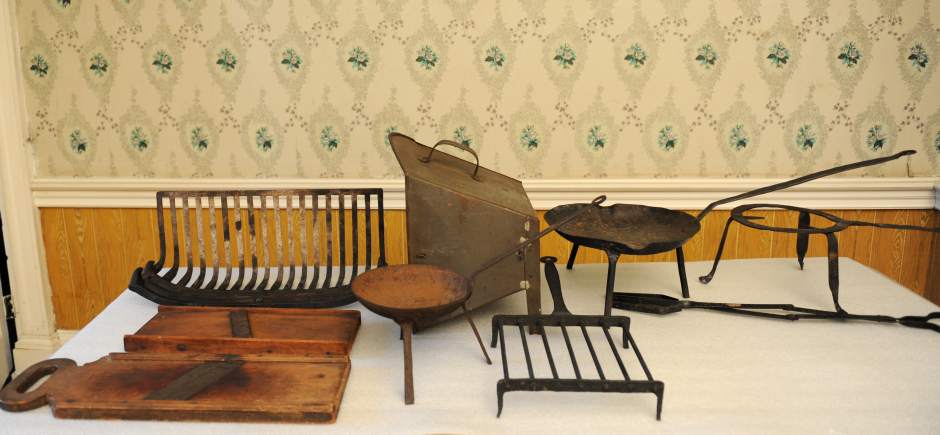
A pair of houses in Ambridge are being given a makeover with some of the most luxurious and comfortable furnishings and finishes — by 1825 standards, anyway.
The George and Frederick Rapp houses, two of the original 14 buildings in Ambridge's Old Economy Village, closed this month for a $1.2 million restoration project.
It will make the conjoined buildings look more like they did when the founder of the Harmony Society and his adopted son lived in them during the 1800s.
“I think (visitors) are going to get a more realistic look than before,” said curator Sarah Buffington.
While tours of the village will continue, the Rapp houses will be closed to visitors until the work is complete in July.
“Up until about 50 years ago, the attitude toward furnishing historic interiors seemed to be, ‘Here's the house of an important person; we're going to furnish it with the best furniture from 1825 we can find,' ” said Gail Winkler, a principal at Philadelphia-based LCA Associates who designed the new interior decorating plan for the houses.
Old Economy Village was the third and final home to George Rapp's Harmony Society, a religious commune that moved from Germany to Harmony, Butler County; then to New Harmony, Ind.; and finally to Economy in 1824.
Though the village became a center of trade and industry on the Ohio River, the society suffered from schisms and dwindling membership until it dissolved in 1905.
Buffington said interior work will include relocating some doorways that had been moved in the 1960s, restoring a kitchen, and re-enclosing a secret vault where the Rapps hid their money.
The vault had been opened up in a previous renovation so visitors didn't really see that it had been hidden. Now visitors will be “let in on the secret,” she said.
Using pieces of original wallpapers and carpets, and detailed inventories from the store at Old Economy Village, Winkler put together a plan to make the houses look more like they did in the Rapps' time.
Wallpapers will be reproduced with 19th-century printing techniques; carpets that look like the originals but are made with more durable materials will cover the hardwood floors, as they did when the Rapps lived there.
Window curtains will be relatively simple, but bed curtains around the four-poster beds will offer complete enclosure, as they would have on cold winter nights.
Buffington said the relative opulence of the Rapp houses compared to the others in the village should help demonstrate why some members grew upset with the Rapps and left the commune over the years.
“The Harmonists were not a religious community that believed in mortification of the flesh — they lived very well,” Winkler said. “They believed that God, in Christ, would return... and that to do good deeds, Christ would need a lot of money, so they amassed a lot of wealth.”
The organization that runs the historic site is still searching for money to convert two rooms of the houses into exhibits on the Harmonists' architecture and town planning. It is also hoping to purchased two cooking stoves from the 1820s-1830s.
Matthew Santoni is a staff writer for Trib Total Media. He can be reached at 412-380-5625 or msantoni@tribweb.com.
