

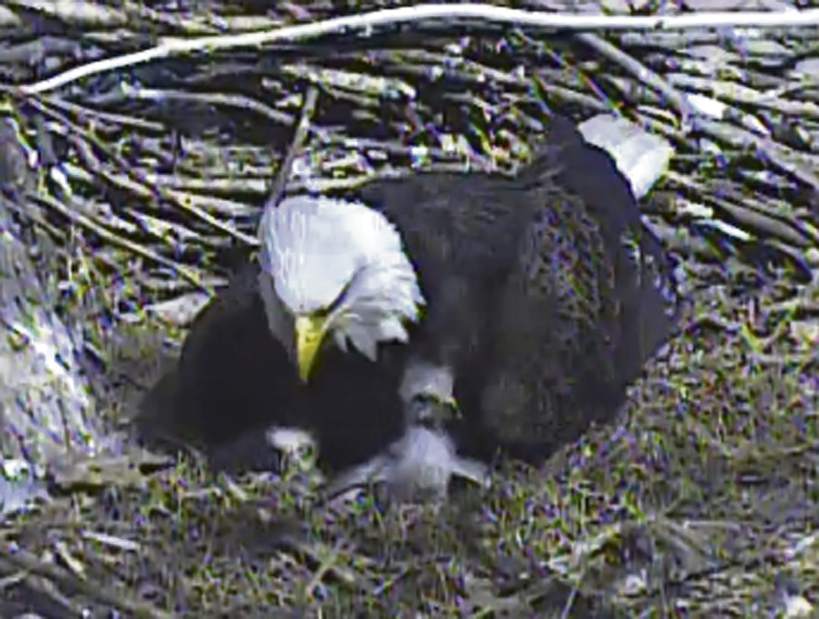
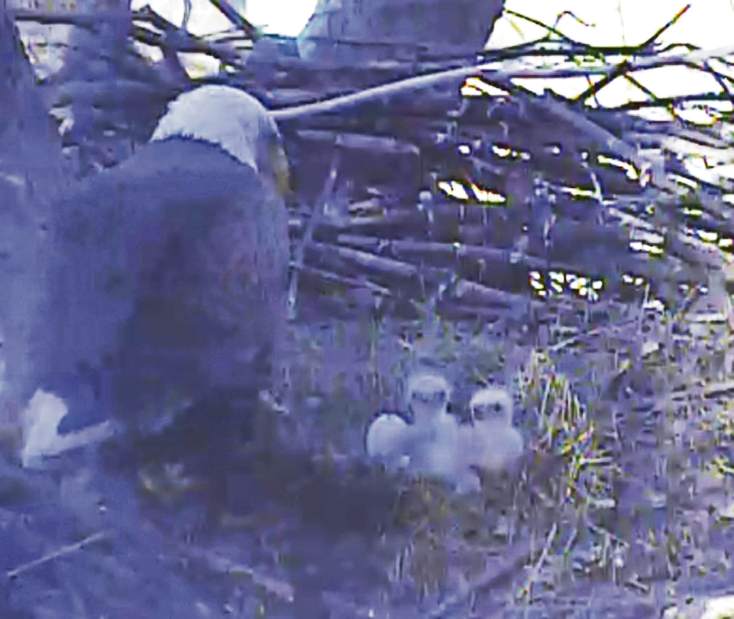

The Pittsburgh bald eagles are batting two out of three this nesting season.
The much-hoped-for hatching of the couple's third egg is unlikely at this point, the Audubon Society of Western Pennsylvania announced Saturday.
There are two healthy and active chicks that hatched last week.
The birds, nesting in the city's Hays section, are the first bald eagles to nest in the city limits of Pittsburgh in at least 150 years. This is their fourth nesting season on a bluff high above the Monongahela River.
A hatch at the Harmar eagle nest is expected later this month. There is at least one egg there.
Although bald eagle eggs typically hatch in 35 days, incubation can take longer.
The remaining Hays egg is 42 days old.
“We wanted to wait a week after the hatch date because there was still a chance for the egg to hatch,” said Rachel Handel, Audubon spokeswoman.
It may be just as well.
If hatched, the third eaglet would be dwarfed by its much larger siblings and would have faced a “severe size and competitive disadvantage to get food,” said Brian Shema, director of conservation for the Audubon Society of Western Pennsylvania.
The bald eagles at Codorus State Park in York County incubated one of two eggs for about 39 days before it hatched Monday.
But the eaglet died on Wednesday, according to the Pennsylvania Game Commission, which operates a live webcam at the nest.
Although the game commission doesn't know the cause of death, about half of eaglets don't survive to leave the nest, said Patricia Barber, a game commission endangered species biologist. Typically, nestlings die from predatation, starvation, birth defects and disease.
Then, after the young eagles successfully leave the nest, only about half of them survive their first year in the wild, Barber added.
The Hays eagles successfully raised three eaglets in 2014 and one in 2013. Last year, two eggs didn't hatch.
The Harmar eagle eggs also failed to hatch last year.
Although the two nestlings at Hays are healthy and well-fed, they still have a long way to go before they leave the nest in June.
The personality of each bird will determine how aggressive the eaglets will behave at mealtime.
“There is some form of communication with posturing, behavior and a hierarchy among the eaglets that is established early on,” Shema said.
Formerly endangered, bald eagle populations continue to grow in the state with 304 pairs recorded in the state in 2015, said Barber.
Mary Ann Thomas is a Tribune-Review staff writer. Reach her at 724-226-4691 or mthomas@tribweb.com.
