
https://archive.triblive.com/news/advocate-architect-rob-pfaffmann-deeply-involved-in-planning-preservation-issues/
Advocate architect: Rob Pfaffmann deeply involved in planning, preservation issues

• |
Andrew Russell | Trib Total Media
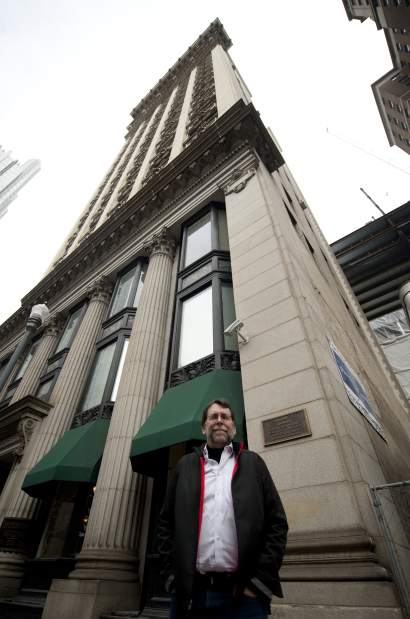
Architect Rob Pfaffmann stands in front of his downtown office, Tuesday, March 17, 2015.
When Rob Pfaffmann took his first class in architecture, the topic was “Social, Economic and Political Factors in Design.”
He remembers the title precisely to this day, as the instructor ardently urged his bright-eyed students to take a role in public planning processes in their communities after they graduated.
That was in the mid-’70s at Syracuse University, and Pfaffmann, now a 59-year-old architect with his own practice here in Pittsburgh, clearly took that early lesson to heart.
Pfaffmann (pronounced foff-mann) seems to be involved in every big planning and preservation issue in the city these days.
He was perhaps the most vocal advocate in the unsuccessful attempts to save and find new uses for the Civic Arena. He took a high-profile position in the successful efforts to prevent the demolition of parts of the historic produce terminal in the Strip District.
And he even worked to try to preserve the three terra-cotta store facades along Fourth Avenue that Point Park University will remove and reassemble in a courtyard (displaying them as historic artifacts) as it makes room for its new Playhouse, Downtown.
In all this, he is engaging in what some in the profession call “advocacy architecture.”
“It’s our job to use our skills and talents to inform the public debate,” Pfaffmann says forthrightly.
The case most often made for advocacy architecture is that architects are trained to turn ideas into pictures — to make ideas visible, as one description puts it. They are accustomed to taking a variety of needs for a building or a site and creating a coherent solution.
That’s valuable in a contentious public debate, as we see so often, where disparate interests of developers, community groups and public officials may collide.
Over the years, Pfaffmann has worked closely with community-development organizations and with the Community Design Center of Pittsburgh. His main tool — other than his architect’s skills — is extensive networking with communities, public officials and developers. He seems to know everybody who is anybody in development and planning circles, as well as in the neighborhoods.
Tall, bearded and bespectacled, Pfaffmann can talk fast, is precisely articulate and is clearly impassioned about his cause. Most often, he is quite affable.
At other times, people who oppose his views can find him quite irritating, readily acknowledging that there are times when he is not the most welcome person in a room.
He doesn’t just argue for a cause, however. He usually illustrates it. In the case of the Point Park University Playhouse, he drew up his ideas and took them to the university to show how the historic terra-cotta facades could be left in place. The original street levels of the facades had been modernized years ago, but he found ways to show what compatible new construction could be like.
In the long run, he sees advocacy as having two components.
“There’s hard advocacy, where you have to fight against property rights or against politics — sometimes you have to rattle cages — and there’s the soft advocacy of education. Architects have to do both,” he says.
Pfaffmann manages to carry on a successful practice as well as his advocacy. His Downtown firm on Fourth Avenue is Pfaffmann + Associates.
Many in Pittsburgh are familiar with his buildings. He partnered with what was then known as EDGE Studio to design the irregularly shaped glass T-station at Gateway Center. In recent years, he’s won awards for designs such as the shelter at Meadowcroft, the new library in the Hill District and the new Highland Avenue bridge connecting Shadyside and East Liberty.
He also designed a small jewel — the Cafe at the Point. That’s the refreshment stand that sits comfortably along a walkway in Point State Park leading to the portal under the highway.
He manages to combine his passion for preservation with an interest in “green” architecture that is energy and resources efficient.
“The greenest building is the one that already exists,” he notes, because the resources that built it have already been spent.
Moreover, he notes, “a lot of the passive design from the past is really very smart.”
He’s currently evaluating energy and other issues at the East Liberty Presbyterian Church, the early 20th-century Gothic-inspired masterpiece of the famous architect Ralph Adams Cram. And he’s finding that Cram’s ideas for things like natural ventilation — neglected over the years — were well ahead of their time. They are “green,” even by today’s standards.
Another current project at his firm is a plan for rehabilitation of the downtown commercial district of Altoona.
John Conti is a former news reporter who has written extensively over the years about architecture, planning and historic-preservation issues.
Copyright ©2026— Trib Total Media, LLC (TribLIVE.com)