




Lawrenceville-based artist Ron Copeland grew up in Canton, Ohio, in the 1980s and '90s, when business in the Rust Belt city was in full swing.
“I grew up on the Lincoln Highway,” he says. “As a kid, I didn't realize how much signage there was until my late teens or early 20s. But where I grew up, in either direction you looked up or down the highway, the entire sides of the road were just blocked with signage.”
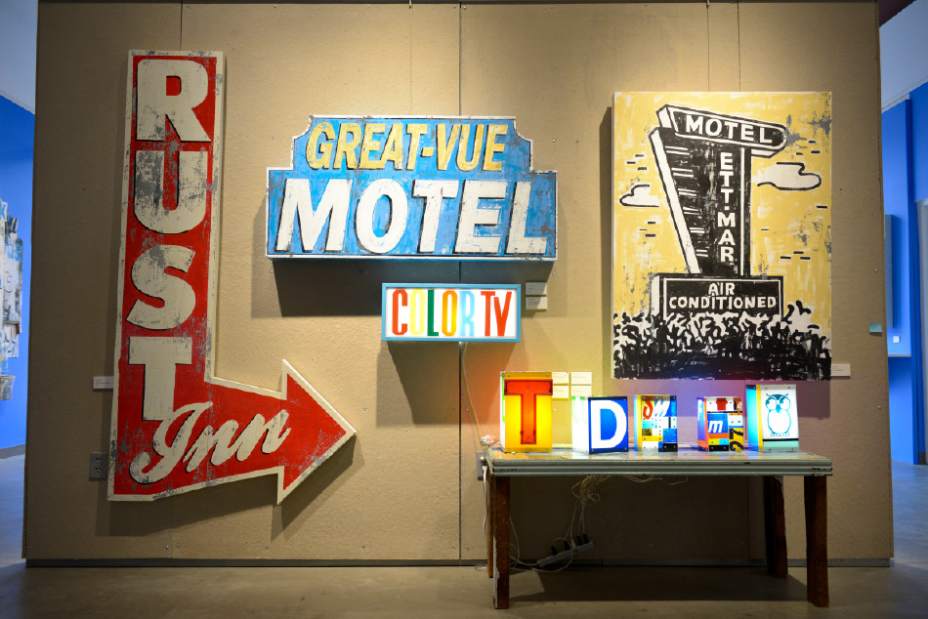
Seeing all that signage is what informs Copeland, 33, as an artist. One look around his solo exhibit “Illuminations” at Borelli-Edwards Galleries in Lawrenceville, and you will see signage, or, rather, the disappearance of it, has had a major influence on his work.
“As I got older,” Copeland says, “I noticed a lot more of these signs being gone than I noticed that they were there. Now I'm fully aware. ... So, now I think I am trying to pay homage to what the landscape looked like where I grew up.”
Copeland keeps a studio just behind the gallery, where he has worked since 2008, shortly after moving to Pittsburgh from Canton.
Before that, he briefly studied graphic design at Kent State University, worked for a commercial printer and sign maker and spent a few years traveling as a professional Rollerblade skater. “I couldn't afford the injuries any longer,” he says in regard to the latter.
Copeland has worked as a picture-framer and gallery assistant to Joy Borelli, owner of Borelli-Edwards.
“I've had a few pieces in different exhibits before, but this is the first time I filled the space,” he says.
The exhibit includes several sign-inspired pieces, as well as a few of the larger wall installations he has become known for.
“Winter in the City,” the largest of Copeland's wall installations, is a perfect example. “They started out as pieces that were small, saleable pieces that could be disassembled easily,” Copeland says of his installations. “But they grew to larger wall assemblages, becoming all one piece.
“With this style of work, I have been able to become more creative, experiment more with materials and visually talk about subject matter that relates to me from installation to installation.”
With its relatively simple color scheme, “Winter in the City” is filled with a variety of materials, ranging from a spray paint can to a window shutter. But overall, it reads as a collage of found signage, with parts of words and advertisements throughout.
Even though the signage looks real, Copeland says, “all the materials are recycled, but I pretty much start with a blank slate with each of them. ... Then, I distress everything and make it look older.”
Although he has a background working on commercial signage, Copeland says, “I'm not technically a sign painter. The way that I paint, I draft everything out then paint it, or I sample something and kind of create images from other images.”
He then adds layer after layer of sign-sampled imagery to get the overall collaged effect. The addition of tools, screws, metal objects and wires add to the effect. “It's the same idea, but making it a little bit more of a painting rather than a collection of materials,” he says.
One cannot help but notice a pop-art influence in some of the pieces. After all, Andy Warhol's early paintings were done in the same hand-painted manner.
And, he admits, “Ever since I was little, I've liked pop art, even though I didn't know who Andy Warhol or Roy Lichtenstein was.”
A rather pop-art inspired piece, “American Industry and Travel Painting #4,” is a standout. It features a man next to a railroad, the source image of which was taken from a copy of Railroad Magazine from 1947.
“This was from a series I did in 2012, where I actually acquired several vintage Railroad Magazines while traveling for a show in Milwaukee,” Copeland says. “Going through them, I started to notice that very small aspects of the photos in each were sort of insignificant to the overall images. In this photo, this man was far in the background, and the train was the focal point of the image. But to me, what was sort of striking, was that this person was secondary to the train in the photo, but in his life, that may have been a very important moment.”
Beneath the painting is an illuminated table made from recycled signage. And hanging in the gallery's front window, several lights are made from recycled signage and recycled Plexiglas, sign vinyl and paint.
As for the lighting, Copeland says, “It's a mix between reclaimed signs and Plexiglas scraps.” Much of the material he uses he has found in antiques stores and sign shops. Even scraps of Plexiglas left from making picture frames at the gallery have gone into the making of these lamps.
Several tables on display also are made of scraps and castoffs.
“A lot of the times, I just use salvaged legs from other pieces of furniture, then get some of the materials for the tops from Construction Junction and the Pittsburgh Center For Creative Reuse in Point Breeze,” he says.
“The wooden tables were something that I dabbled in for a long time, but now they have become sort of a necessity to showcase the lamps,” Copeland says.
Admittedly, Copeland says, “I like to build everything for each show, so I kind of control the environment.”
And stepping into this show is a bit like stepping into the Rust Belt world of the artist's youth.
Kurt Shaw is the art critic for Trib Total Media. He can be reached at kshaw@tribweb.com.
