

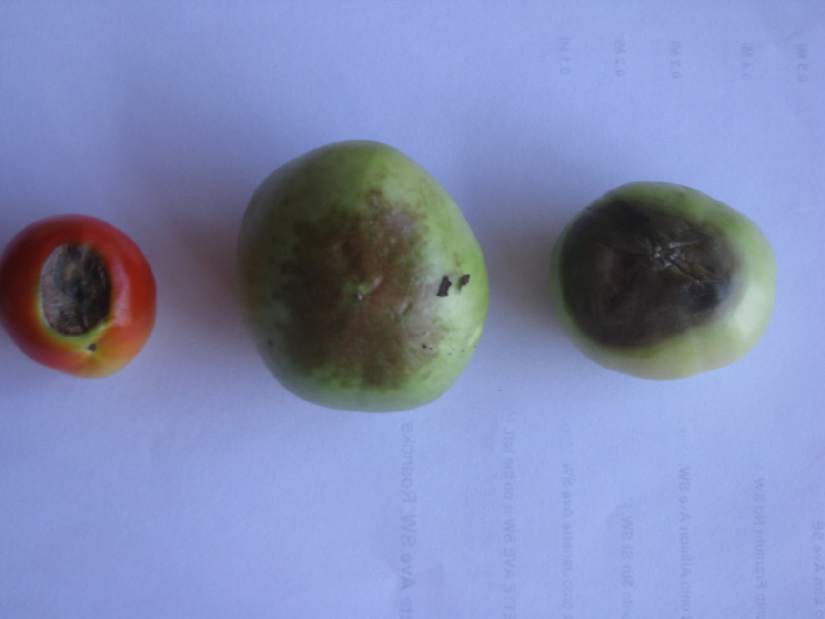
Question: I am sending you pictures of my tomatoes. They have some kind of disease, but the plant itself looks healthy. The plants were in a pot on my covered deck, so I watered them regularly and used Miracle-Gro for tomatoes. Can you tell me where I went wrong so I can correct my methods for next year?
Answer: Your tomatoes are showing classic signs of blossom end rot. The black, sunken cankers on the bottoms of the fruits are typical of this ailment. Thankfully, it's easy to prevent. But first, it's important to understand why your tomatoes developed it in the first place.
Blossom end rot is the result of a calcium deficiency within the growing fruit. If the plants cannot acquire enough calcium during fruit development, the base of the tomato will become discolored and mushy. However, the problem is usually not remedied by adding more calcium to the soil, as some people may think, but rather by making sure the plant is properly watered. Let me explain.
Unlike some other nutrients, calcium is acquired by a plant primarily through a process called “mass flow.” This means the nutrient can come into the plant only via the water absorbed by the roots. If there isn't enough water coming into the plant, it can't access enough calcium, even if there's plenty of it in the soil, and the plant begins to show signs of a calcium deficiency.
Here in Western Pennsylvania, our soils typically have ample calcium, so soil calcium deficiencies are unusual in a garden setting. The calcium is in the soil; your plants just can't access it unless they have ample and consistent water. The same goes for plants grown in pots, especially if they're grown in a commercial potting soil with added fertilizer or potting soil mixed with compost. The calcium is there; your plants just aren't getting it.
Because you mentioned that your pots were grown on a covered deck, they probably did not have regular access to rainwater, and the water you were adding via hose-end irrigation was not enough.
A few tips for next year that will help prevent blossom end rot:
1. Make sure each tomato plant is growing in a pot that holds a minimum of five gallons of potting soil. The bigger the pot, the bigger the root system and the healthier the plant. Each container also should have a drainage hole in the bottom.
2. Proper watering is not adding a little water to the pot every day. Proper watering is using a hose to thoroughly saturate the soil every two to four days. I add five or six gallons of water, at minimum, to each of my potted tomatoes every few days throughout the summer. This is very important, especially if your tomatoes are growing somewhere where rainwater can't reach them. As long as the pot has a drainage hole and it isn't sitting in a saucer of water, it's nearly impossible to overwater them. Deeper, less-frequent irrigation is always better than adding a little bit of water every day.
3. As I mentioned earlier, if you planted your potted tomatoes in a commercial potting mix with fertilizer already included, there was ample calcium present. Miracle-Gro tomato fertilizer supplies nitrogen, phosphorous and potassium, but it does not contain calcium. I suggest you mix your potting soil next year half-and-half with compost (either purchased in bags or from your own pile). It has a blend of macro- and micronutrients and supports good tomato growth. Plus, it increases the water-holding capacity of the potting soil. Another option would be to mix a half-cup of organic-based, granular fertilizer into the potting soil-compost blend at the start of the season. Espoma's Tomato-tone or Gardener's Supply Co.'s Organic Tomato Fertilizer are two good choices.
Horticulturist Jessica Walliser co-hosts “The Organic Gardeners” at 7 a.m. Sundays on KDKA Radio with Doug Oster. She is the author of several gardening books, including “Attracting Beneficial Bugs to Your Garden: A Natural Approach to Pest Control” and “Good Bug, Bad Bug.” Her website is jessicawalliser.com.
Send your gardening or landscaping questions to tribliving@tribweb.com or The Good Earth, 503 Martindale St., Third Floor, D.L. Clark Building, Pittsburgh, PA 15212.
