

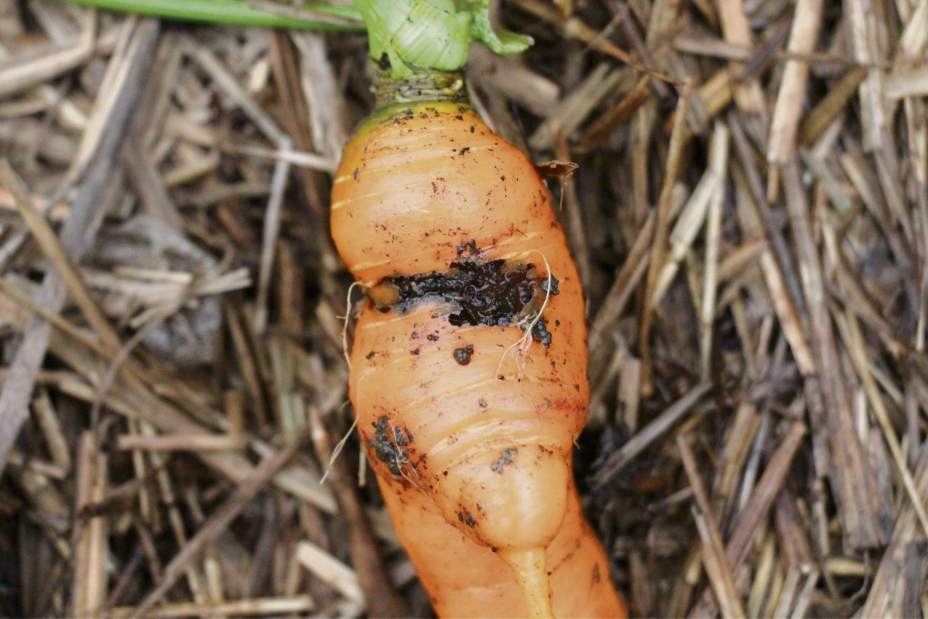
Question: We grow carrots in our garden every year, and we usually have good luck with them. However, the last three or four years, a good percentage of the carrots have scars and tunnels eaten out of them, especially toward the top of the root. We cut these scars out and eat the rest of the carrot, but we'd like to not have to do that again this year. There are never any bugs in the scars or tunnels, but I'm sure it's a little critter of some sort. Can you help us please?
Answer: When you dig up your carrot crop and find roots with tunnels like the ones you found, the likely culprit is the carrot rust fly (Psila rosae).
As adults, these tiny flies are shiny black with an orange head and legs. You seldom see the adults in the garden because they're so small and fast-moving, but their larvae are hard to miss.
Adult flies overwinter in the garden and surrounding areas. Come spring, they emerge, breed and lay eggs near their host crops. Carrots aren't the only susceptible vegetable; carrot rust fly larvae also attack parsnips, celeriac, parsley and celery, among others.
The tiny larvae immediately burrow down into the soil and begin feeding on the immature root, leaving behind their tell-tale tunnels. The larvae continue to develop as the growing season progresses, and as they do, their damage becomes more and more substantial.
Thankfully, there are a few easy things you can do to limit carrot rust fly damage, without having to use any chemical pesticides.
First, because carrot rust fly adults have a limited flight range, make sure you rotate crops in your garden. Plant your carrots in a new place every year, even if it's just a few feet away from where they were the previous season. Carrot rust flies locate host plants through odor cues, so try to choose a new planting site that's downwind of wherever they were the year before. Carrot rust fly adults prefer to fly upwind.
Also, the overwintering generation of carrot rust flies begins to breed in April and early May, so delaying the planting of your first carrot crop by a few weeks often means your crop won't be in sync with the carrot rust fly's breeding cycle. Wait until late May or early June to plant carrots and you'll be between generations of carrot rust fly, because the second breeding cycle doesn't occur until August or September.
In addition to these techniques, you can also cover your carrot plants with floating row cover. For the female flies to lay their eggs, they have to have access to host plants. But, if you cover your young carrot seedlings with floating row cover, the flies won't be able to get to the plants.
You may also find that inter-planting your carrots with members of the onion family, such as garlic, chives and onions, may help limit damage as well. As mentioned earlier, carrot rust fly adults find their host plants primarily through smell, so odorous companion plants like these may mask the carrot's distinct fragrance.
You should also properly dispose of infested carrot roots. Instead of tossing them onto the compost pile where the larvae can continue to develop and produce a new generation, put them in the garbage.
Horticulturist Jessica Walliser co-hosts “The Organic Gardeners” at 7 a.m. Sundays on KDKA Radio with Doug Oster. She is the author of several gardening books, including “Attracting Beneficial Bugs to Your Garden: A Natural Approach to Pest Control” and “Good Bug, Bad Bug.” Her website is jessicawalliser.com.
Send your gardening or landscaping questions to tribliving@tribweb.com or The Good Earth, 622 Cabin Hill Drive, Greensburg, PA 15601.
