
https://archive.triblive.com/news/celebration-marks-100-years-for-south-side-market-house/
Celebration marks 100 years for South Side Market House

• |
Stephanie Strasburg | Trib Total Media
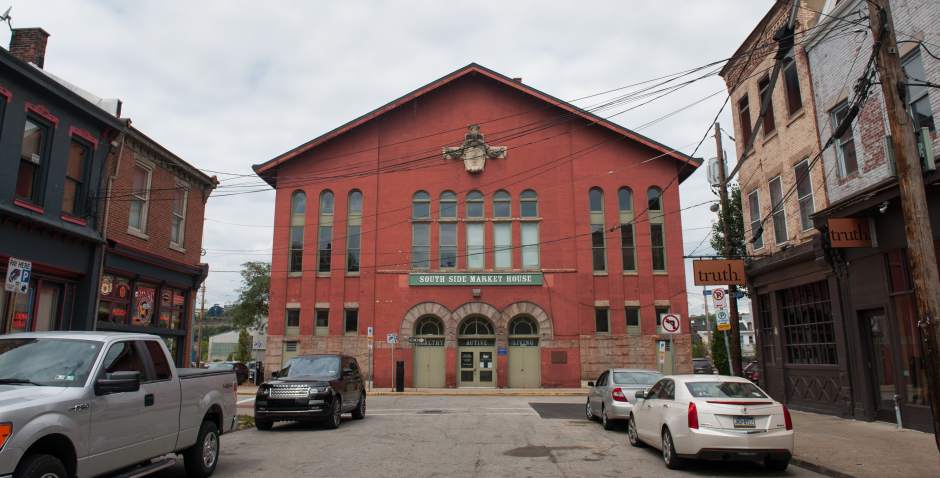
The South Side Market House, celebrating its centennial year after being rebuilt in 1915 due to a fire, used to serve as a meeting place and food store. The building is pictured here in the South Side on Wednesday, Aug. 26, 2015. Due to repeated fires, this is the fifth market house to be built on this space in Bedford Square.
Despite five fires that caused major damage between 1893 and 1915, the South Side Market House has endured — and a time capsule even survived in a cornerstone of the building.
A centennial celebration Aug. 29 of the Market House — one of only two remaining in the city — includes unveiling the time capsule that researchers discovered. It contains some metal objects and mostly disintegrated papers, but is a fascinating portrait of history, organizers say.
The South Side Market was like a big flea market with grocery stands selling produce, meat and other food. Livestock was brought to the basement and slaughtered on site, and the basement of the building still has catacombs with stalls.
“The Market House was once a common place for people to meet and greet and buy your meat,” says Andy Masich, president and chief executive officer of the Senator John Heinz History Center in the Strip District. “You could get just about anything from a Market House. It’s a great old building and … it is a time to celebrate our historic building.”
Today, the Market House — designed in the Victorian era by prominent architect Charles Bickel — is used mostly as one of 14 healthy-living senior centers run by the city, says Sarah Johnston, center director of South Side Market House. Upstairs is a gymnasium that is often used for recreational and sporting activities on evenings and weekends, she says.
The seniors who come to the center have a great appreciation for the building’s history along with memories, such as picking up boxes of food there when the steel mills closed, Johnston says.
“It’s always been a historical landmark in their minds, as well — a place that either they remember going with their parents to go grocery shopping, or they remember sending their kids there,” she says. “It’s always been a place for the people of the South Side or anywhere in the city of Pittsburgh to come and spend time. It’s very interesting because generations of people have memories of the Market House. It’s near and dear to people’s hearts.
Several fires broke out at the Market House, but the last and most severe one happened a century ago. In this 1915 fire that destroyed the roof, “pretty much all that was left was the four brick walls,” Johnston says. So the current incarnation of the building came the same year.
The celebration includes food vendors, live music and a children’s area with the Citiparks Roving Art Cart, balloon sculptors, a bounce house and visits with Mr. McFeely of “Mister Rogers’ Neighborhood.”
“We really are trying to have this as a celebration of the community,” Johnston says.
Jim Griffin, director of Pittsburgh Citiparks, says he expects a wonderful celebration for the Market House, which is “a real landmark of the South Side.”
“It’s a beautiful building. It sits in its own square. It’s been a cultural magnet for more than 100 years, but this version of the Market House has been there for 100 years,” Griffin says.
“As soon as you walk into the building, it’s a welcoming, warm place,” he says. “It was the original farmers market.”
The celebration aims to “make people understand the value and appreciate the things we offer today, and it’s not just a history lesson,” Griffin says. “It’s an important part of the community today.”
Kellie B. Gormly is a staff writer for Trib Total Media. She can be reached at kgormly@tribweb.com or 412-320-7824.
Copyright ©2026— Trib Total Media, LLC (TribLIVE.com)