
https://archive.triblive.com/news/century-old-train-station-among-projects-getting-help-from-grants/
Century-old train station among projects getting help from grants

• |
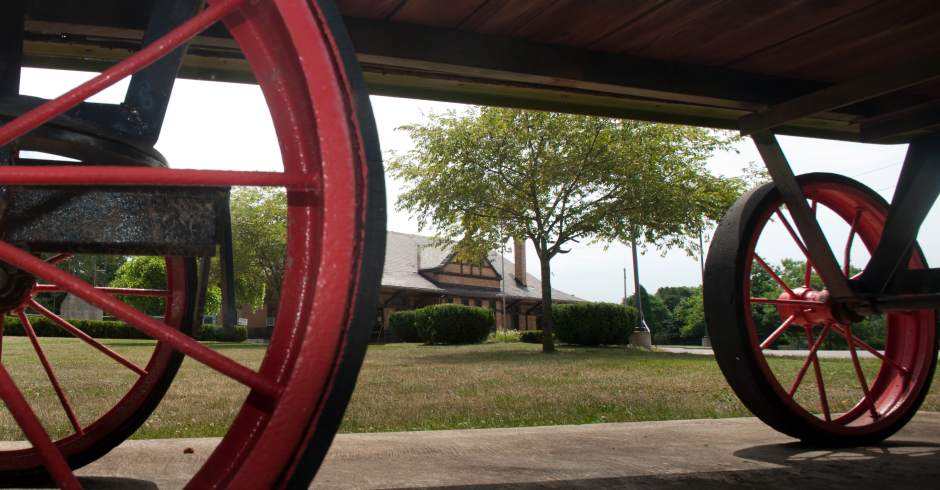
The Beaver Area Heritage Foundation is introducing a fundraising campaign to raise money to renovate former Pittsburgh & Lake Erie Railroad station into a multiuse cultural and event center. First on the list of improvements for the Beaver train station is fixing the old slate roof, as shown here through the red wheels of old railroad equipment on display on Friday. Stephanie Strasburg | Tribune-Review
An ambitious vision to revive a 115-year-old former train station as the focus of a two-acre cultural and events center in Beaver is getting help from a state agency that’s spreading scarce resources to preserve the past.
The Pennsylvania Historical & Museum Commission in June awarded a total of $500,000 to 25 historic preservation groups statewide, including $25,000 to the nonprofit Beaver Area Heritage Foundation, which is starting a $1.4 million fundraising campaign to renovate the former Pittsburgh & Lake Erie Railroad station on East End Avenue.
It housed Beaver County’s 911 Center for decades. Beaver Borough purchased the station in 2010 after the 911 center relocated to Ambridge. Borough officials asked the heritage foundation to study restoring and reusing it, as the foundation had done in the late 1990s with the nearby freight station, now the Beaver Area Heritage Museum.
“We’re excited about it,” said Bob Rice, a member of the foundation’s board. “It will be converted into an events center that could be used for family gatherings, seminars, weddings and other events.”
Outside groups plan to use space in the renovated station, including the Beaver County Genealogical and History Center and the Sewickley-based Sweetwater Center for the Arts, which is seeking additional classroom space.
The state grant will help defray the cost of repairing the station’s slate roof, the most immediate need, Rice said. The group is seeking donations to cover other costs.
“It’s not going to pay for it, but it’s certainly a good leg up. We are just getting off the ground,” he said.
Money for the Keystone Historic Preservation Grant program comes from a
tion of Pennsylvania’s 1 percent real estate transfer tax. Grants of up to $100,000 used to be available, but the commission reduced the maximum to $25,000 so it could spread money around, since state funds have at times been scarce and fluctuating, said Karen Arnold, the grant program’s manager.
The transfer tax brought in $321.7 million during the 2010-11 fiscal year, down 7.2 percent from the previous year. Almost all of it goes to the state’s general fund. The grants began in 1993.
“We always require a 50-50 match to show that (applicants are) committed, and that they’re being careful stewards,” Arnold said.
The grants are intended to improve historic sites that are either eligible for or already listed on the National Register of Historic Places. Historic preservation groups that receive money must agree to keep their program or facility open to the public for at least 15 years, she said.Phipps Conservatory and Botanical Gardens plans to use its $25,000 award to repair joints and glass that make up the Oakland facility’s signature Lord & Burnham glass house complex built in 1893.
“It’s the heart and soul of the conservatory and it’s a treasure of the city,” said Natalie Bowman, a spokeswoman.
In Moon, city planners said they will use a $10,000 grant to hire a consultant to formulate a historic preservation plan for the western suburb of Pittsburgh. The township has applied to qualify the Mooncrest Historic District for the National Register of Historic Places. The federal government built the neighborhood in 1943 to provide housing for workers who produced “armor plate, munitions and ships at the nearby Dravo Corp.” during World War II.
The homes were sold to private buyers in the mid 1950s. The 42-acre neighborhood used to be the home of Moon’s municipal building, police station, school and a market.
Lora Dombrowski, Moon’s code administrator, said the township is seeking old photos and information about the original Mooncrest neighborhood for a book and a classroom lesson that could be taught to Moon Area School District students
Jeremy Boren is a staff writer for Trib Total Media. He can be reached at 412-320-7935 or jboren@tribweb.com.
Copyright ©2026— Trib Total Media, LLC (TribLIVE.com)