

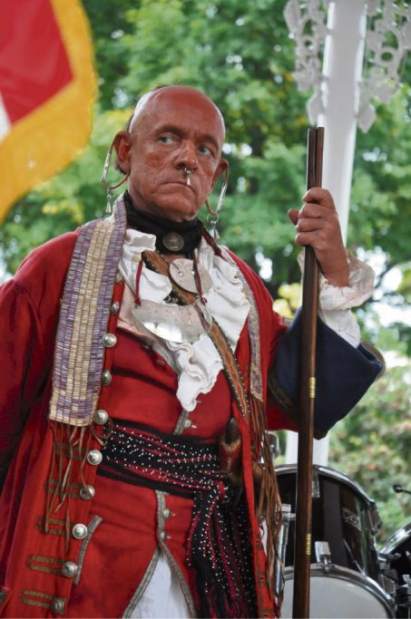
Dozens of people gathered on the Diamond Friday afternoon to mark Fort Ligonier's 257 years along the banks of the Loyalhanna Creek.
“We are in the pages of this country's history,” said Mayor Ormond “Butch” Bellas.
In line with Fort Ligonier Days' tribute to the town's legacy, the English invited back one of its allies to join in the fanfare.
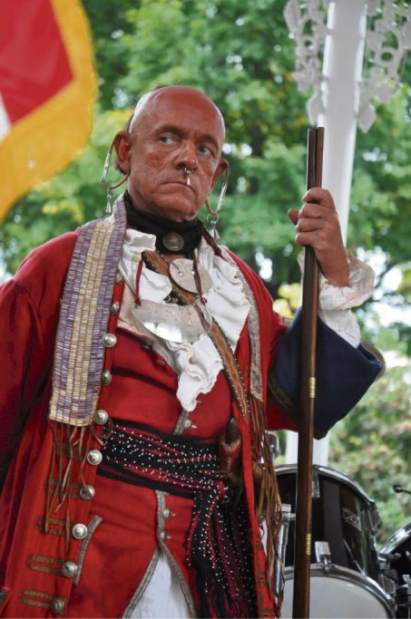
Cherokee Peace Chief Attakullakulla spoke of his nation's involvement in the French and Indian War during the 56th annual festival's opening ceremonies. Retired Capt. Robert K. Rambo, 55, of North Carolina, has portrayed the chief since 1993.
“For about 50 years in the 18th century,” Attakullakulla, also known as the Little Carpenter, led his nation through very trying times,” Rambo said. “In the midst of that, we fought many wars, including many wars to help protect the English from which this town has arisen.”
Ligonier was “the frontier of a bloody and hard-fought war, as well as settlement” when Cherokee warriors arrived.
“The Cherokee came here to fight in just one of many wars, in which we helped the English to fight against the Spanish down in Georgia and Florida, against the French in Louisiana territory, Illinois territory and New France Canada territory in many different wars,” he said. “Ten years before these events here, my character Attakullakulla was held as a prisoner of war in New France in Canada for seven years during what was called King George's War. The Cherokee had fought many wars against the French with our English allies and trading partners.”
The Cherokee mixed their blood with English allies and trading partners, he said, because since the founding of Charleston, S.C., in 1670, all of the traders who brought goods to the Cherokee was required to marry a Cherokee wife in order to complete the transaction.
“By 1730 we had generations of mixed blood children,” Rambo said.
Attakullakulla's other moniker, The Litter Carpenter, was born out of his ability to form a strong alliance with King George II in London.
“It was said just as a carpenter could join wood to make it fit well and build things like this fort out of wood and timbers, Attakullakulla was able to build a very strong alliance between the English and Cherokee,” he said.
In the French and Indian War, the Cherokee sent up to 1,000 warriors back and forth to the Pennsylvania frontier and in Choctaw country around what is now Mississippi and Illinois. Even before the war, Attakullakulla led warriors to Illinois country in 1751 and 1752, taking scalps to Williamsburg, Va., as a show of faithfulness to the governor.
“(Attakullakulla) had promised George the Second in London we would always love our English brothers and sisters and that we were all one people made by the same creator above,” he said. “It is a pleasure to see now that this town has prospered and become a pleasant, welcoming and hospitable place.”
After his speech, Attakullakulla spent the rainy afternoon under his lean-to at Fort Ligonier.
“I hope I can come back, but I hope it will be drier,” he said. “I do believe these British forces have brought their British weather.”
He said the staff was very helpful in coping with the deluge, offering him tea to brew over his campfire.
“Anytime you share tea with someone, they become your friends,” he said, “except the French.”
The chief spoke with visitors to the fort about the Cherokees' participation in the Gen. Forbes campaign against Duquesne, the relationship between the Cherokee and the British and 18th-century Cherokee culture.
Rambo has portrayed the chief at all kinds of venues. He said Fort Ligonier has a “fantastic artillery collection, great fortifications and extremely cordial staff.”
Nicole Chynoweth is a staff writer for Trib Total Media. She can be reached at 724-850-2862 or nchynoweth@tribweb.com.
