

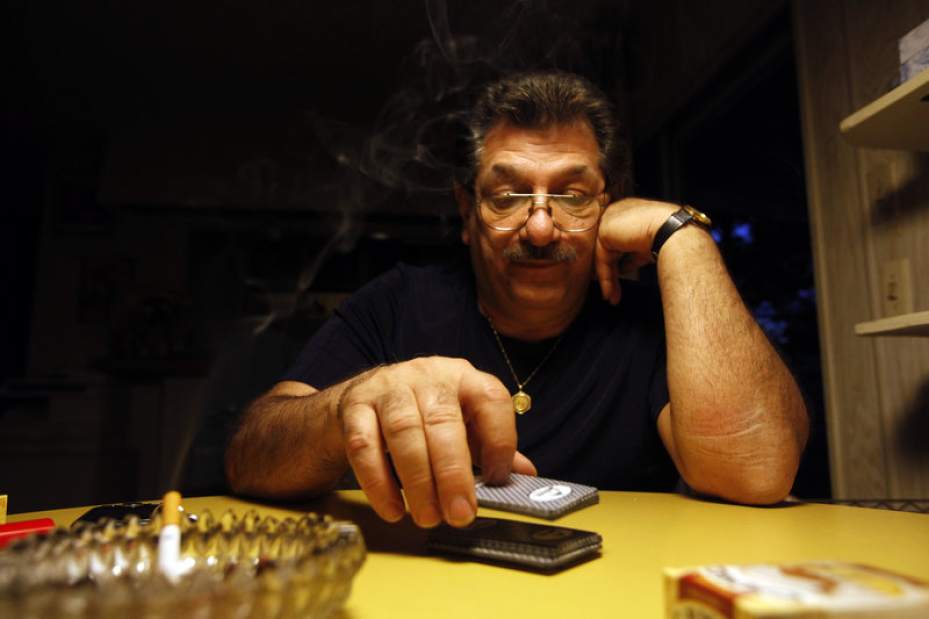
LAS VEGAS — Frank Citro Jr. is holding court at his regular table at a dingy roadhouse, about as far from the glamour of the Strip as you can get.
Men in suits stop to pay their respects, some kissing the cologne-splashed cheek of the guy they call Frankie. It's a gesture of affection, like those of his neighborhood cronies in Jersey City, back in the old days.
But more recent days have not been so kind to Frankie. He loves this live-music joint — don't get him wrong. When you're Frank Citro Jr., there are only so many nightspots in this town where you're still welcome.
For 23 years, Frankie has been included in Nevada's Black Book, officially the “Excluded Person List,” an index of desert undesirables blackballed by the state's casino regulators. Since its inception in 1960, the book has included mobsters such as William “Icepick Willie” Alderman, Murray “The Camel” Humphries and Chicago crime boss Sam “The Cigar” Giancana.
Black Book inclusion means you cannot own, manage or even enter a casino. The only way off the list is to die, and even then state regulators require a death certificate as proof that you are truly departed.
Now the 68-year-old Frankie is attempting something never tried in the book's history: He wants off the list while he's still alive.
“I don't belong in this book,” he said in his thick Jersey accent, an unlit Camel dangling from his lips. “I never cheated a casino, never had a fight there. I'm just supposedly a notorious felon. There are lots of felons in this town. Why me?”
The move has caught Nevada's Gaming Control Board by surprise, and officials had to consult their rules to determine that the challenge is indeed allowable. Now Frankie is collecting documents and contacting character witnesses before his attorney requests a hearing with the board.
“For someone to come forward after so many years on the book,” said James Taylor, deputy chief of the Gaming Control Board enforcement division, “that's something that's never been tried before.”
In 1985, Frankie and six others were convicted of bookmaking and loan-sharking operations in Southern California and Las Vegas that prosecutors said charged clients as much as 1,000 percent interest. He spent two years in prison.
To gaming officials, the verdict — not to mention the fact he had consorted with known mobsters — made him the kind of notorious character they didn't want in Nevada's casinos. So they put him in the Black Book, a distinction that dims even the brightest lights of Sin City. Being inside a casino, he knows, can mean arrest and even jail time.
Frankie says the book discriminates against Italian Americans — half of the list's 33 current members have Italian surnames — and promotes Mafia stereotypes. This in a city that has embraced its organized crime roots with not one, but two, mob museums.
Frankie is stubborn. Since being placed in the book in 1990, he has refused to leave Las Vegas to avoid the slightest hint of surrender. He continues to embrace a street-wise image, making wisecracks, gesturing with his hands and shoulders, ending sentences in “boom, boom, boom.” He likes to say he knows only two real tough guys, and the other one sends him a Christmas card every year.
For a quarter-century, Frankie has avoided jail and is off probation. He donates time to charity — rounding up bands and singing his beloved doo-wop music at fundraisers.
But sometimes it seems Frankie has tried to capitalize on his past. He briefly starred in a series of Internet skits called “Frankie's Way: Real-Life Wise Guy,” which producers unsuccessfully sought to sell to cable television.
So why embrace the stereotype when he's trying to rebuild his reputation?
“It's all I've got left,” he said of his persona. “They've made it so I can't find work in this town. It's like I have leprosy.”
Critics call the book an outdated relic of an era when wiseguys called the shots. Card cheats and slot crooks now pose a bigger threat to the industry, and some appear on the list. The last entry, Philadelphia mobster Frank Bulgarino, was added in 2004.
Some friends have turned their backs on Frankie, but he has new believers in his camp.
Like the North Las Vegas police officer he helped raise money for children with cancer. “I'm a cop. I deal with lots of people who did things 40 years ago, now trying to eke out a living,” Steve Noahr said. “You pay your debt to society. Why be persecuted for life?”
Former Nevada Lt. Gov. Lonnie Hammargren said that “if anyone gets off that list, it should be Frankie.”
He added: “It's not just his past that put him in that book; it's where he came from, his speech, his accent. At this stage, he's probably cleaner than 90 percent of corporate Las Vegas making deals behind closed doors today.”
