

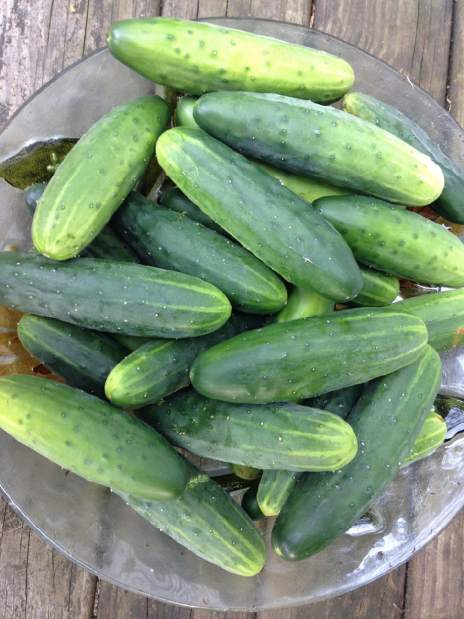
If you're a vegetable gardener, you know how important variety selection is. But, it's smart to pay attention to more than just a particular variety's flavor or appearance when deciding which vegetables to grow in your garden.
Selecting vegetable varieties based on traits such as good disease resistance and the right growth habit is a smart decision, especially when it comes to cucumbers.
While many of us spend hours deciding which varieties of tomatoes and peppers to grow, few gardeners put much thought into picking the best cucumbers for their garden. We should, though, because the truth is that there's nearly as much variation in flavor, texture, disease resistance and growth habits among cucumbers as there is among sweet peppers. In other words, don't go to a garden center and buy the first cucumber plants or seeds you see. Spend some time investigating the properties of each selection before deciding which ones are right for you.
Here's what to consider before deciding which varieties of cucumbers to plant in your garden this summer.
First and foremost, plant for disease resistance. Certain cucumbers are prone to bacterial wilt, a devastating disease transmitted by the cucumber beetle. Bacterial wilt can wipe out a cucumber crop practically overnight, and rather than battling the cucumber beetle, it's far easier to manage this disease by planting varieties that are resistant to this pathogen. A few good choices are “Marketmore 76,” “Darlington,” “Salad Bush,” “County Fair,” “Saladin” and “Jackson.”
Next, consider the growth habit of different varieties. If you garden in a small area or in containers, consider growing a bush-type cucumber. Instead of producing fruits on a 10-foot-long vine, bush cucumbers form fruits on a 1- or 2-foot-wide mound of foliage. Bush cucumbers provide an excellent harvest in a very small space. Good bush varieties include “Bush Pickle,” “Patio Snacker” and “Salad Bush.”
If, on the other hand, you have a lot of room to grow your cucumbers — or, like me, you grow them up a fence or trellis — select varieties known for their high yields. Over the years, I've grown many cucumber varieties touted as being high-yielding, and I've come to appreciate a few favorites. My hands-down favorite is “Marketmore 76” (which is also resistant to bacterial wilt). I also grow a spine-less, thin-skinned selection named “Diva,” the nonstop producer “General Lee” and a heat-tolerant Asian cucumber I adore called “Suyo Long.”
You should also put some thought into the purpose of your cucumbers. If you want cukes for slicing in salads and fresh eating, then slicing cucumbers are for you. But if you plan to make homemade pickles, then look to pickling varieties for the best fit. I find the best picklers to be “National Pickling,” “County Fair” and, if you grow gherkin-types, “Adam” or “Diamant.”
One final item to consider: funkiness. If you like to experiment with more unusual varieties, there are a few that will fit the bill. “Miniature White” is a cute, super-sweet cucumber that's only 3 inches long at maturity. The fruits are white to pale green, and the plant's growth habit is slightly compact. It's an easy variety to grow in containers or raised beds. The bitter-less fruits are excellent when eaten fresh in salads or pickled.
Another novelty cucumber with great flavor is “Silver Slicer.” I tried this cucumber for the first time last year and loved its creamy-white color and smooth skin. With a mild flavor, juicy texture and small seed cavity, “Silver Slicer” will find a home in my garden again this year. Plus, it looked great climbing up over the garden fence.
Seeds of these and other cucumber varieties are available at certain local nurseries, as well as through online seed purveyors, including HighMowingSeeds.com, TerritorialSeed.com and JohnnySeeds.com.
Horticulturist Jessica Walliser co-hosts “The Organic Gardeners” at 7 a.m. Sundays on KDKA Radio with Doug Oster. She is the author of several gardening books, including “Attracting Beneficial Bugs to Your Garden: A Natural Approach to Pest Control” and “Good Bug, Bad Bug.” Her website is jessicawalliser.com.
Send your gardening or landscaping questions to tribliving@tribweb.com or The Good Earth, 503 Martindale St., 3rd Floor, D.L. Clark Building, Pittsburgh, PA 15212.
