
https://archive.triblive.com/news/education-classroom/betsy-devos-green-lights-pennsylvanias-every-student-succeeds-act-plan/
Betsy DeVos green-lights Pennsylvania’s Every Student Succeeds Act plan

• |
REUTERS
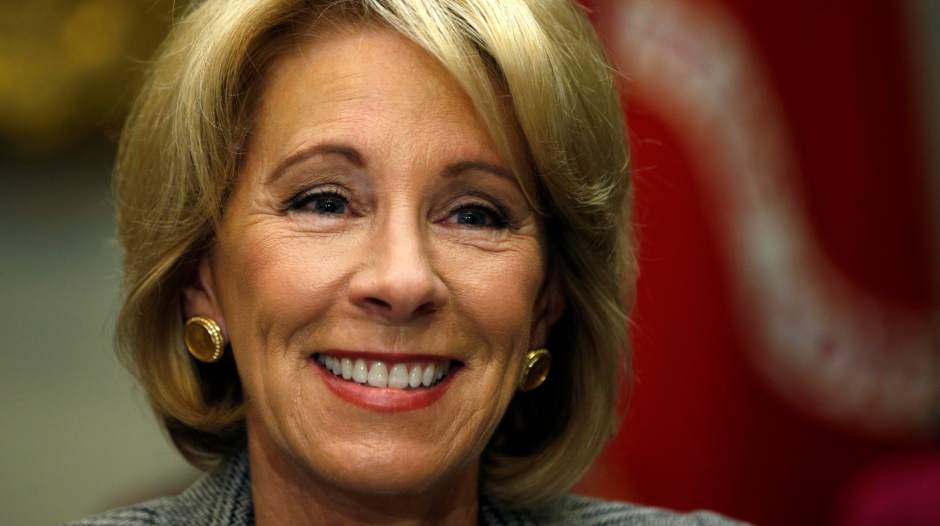
U.S. Secretary of Education Betsy DeVos
The Trump administration has approved Pennsylvania’s Every Student Succeeds Act plan, along with the mandatory education improvement proposals submitted by 10 more states, Education Secretary Betsy DeVos announced Tuesday night.
“Pennsylvania’s plan met the requirements of the law, and so I am happy to approve it,” DeVos said in a statement shortly before 9 p.m. “This plan should not be seen as a ceiling, but as a foundation upon which Pennsylvania can improve education for its students.
.@BetsyDeVosED approves #ESSA plans for Arkansas, Maryland, Missouri, New York, Ohio, Pennsylvania, Puerto Rico, South Dakota, Washington, Wisconsin and Wyoming.
— Politics K-12 (@PoliticsK12) January 17, 2018
Under the Every Student Succeeds Act , or ESSA, all states were required to revamp guidelines for monitoring academic achievement, graduation rates and English learner proficiency. The ESSA replaced No Child Left Behind as the federal education law following a bipartisan effort toward the end of the Obama administration in 2015. Specific to Pennsylvania’s pitch were efforts to measure how prepared students are to find jobs after high school and to reduce chronic absenteeism. The plan is required for federal funding. This week’s approval follows an eleventh-hour scramble by state lawmakers and officials to respond to concerns about portions of the plan flagged in a letter sent to shortly before Christmas. State Education Secretary Pedro Rivera touted Pennsylvania’s final plan for reflecting “our guiding principles of transparency, equity and innovation” and increasing the flexibility of schools. Long-term goals under the new plan include reducing the number of students who fail to graduate, increasing the number of students who achieve proficiency on PSSA and Keystone Exams and supporting English Language Learners in growth toward achieving English proficiency. “We are particularly proud of the extensive stakeholder engagement efforts undertaken during the planning process,” Rivera said Tuesday in a statement, “which ensure that the plan aligns with the needs and priorities of Pennsylvania’s educators, students and communities.” I have also proposed $2M in state funding + $1M in federal funds to further address accountability and align with the goals of ESSA. https://t.co/06VY8spvK4
— Governor Tom Wolf (@GovernorTomWolf) March 30, 2017
Now, Pennsylvania education officials must get to work helping local school districts implement the changes. Parents and educators have lauded the piece of the plan that Gov. Tom Wolf says means third- through eighth-graders will spend on average 20 percent less time on testing. Some sections of the Pennsylvania System of School Assessment tests, or PSSAs, have been removed and other sections have been shortened. I'm grateful and proud that @PADeptofEd has reduced #standardizedtesting, included #career education at the elementary level in their #ESSA plan, and is investing in #STEMlearning. We spoke. They listened. Thank you @GovernorTomWolf & @pedroarivera2 for putting kids first! pic.twitter.com/GOmxoqva1Q
— Mandi Figlioli #magicinthemaking (@mrsfigmakes) December 8, 2017
In contrast, critics such as education advocacy groups and state lawmakers have lambasted the plan for its limited details on how it will hold schools accountable and measure students’ academic performance, teacher quality and overall school performance. The #ESSA plan is "scant on any details regarding specific interventions [for struggling schools]" – @JonathanCetel https://t.co/kigXhbGTMB
— PennCAN (@PennsylvaniaCAN) August 3, 2017
The chairmen of the state Senate and House education committees went so far as to deride the plan as a “step backwards for this Commonwealth” in a joint statement this past fall. They expressed their disappointment that the Wolf administration did not incorporate any of their suggested changes during the 30-day public comment period prior to the state’s submission in late September. Among other grievances, Republican lawmakers and pro-school choice group PennCAN faulted Pennsylvania’s ESSA plan for scrapping the state’s use of School Performance Profiles that assign a summative score to local school districts. Instead, the Wolf administration is switching to a system it calls the Future Ready PA Index — a change that critics have lamented could make it difficult for parents and taxpayers to compare schools across Pennsylvania’s 500 school districts. The Future Ready PA Index, a new school report card that measures academic growth, school climate, graduation rates and readiness for opportunities after high school, will not assign schools a letter grade or numerical score. It will allow schools to include local assessment data, making it difficult to draw apples-to-apples comparisons between schools and over time. Of 17 states that submitted ESSA plans to the U.S. Department of Education last spring, 15 proposed using a summative rating. How strong are #ESSA plans when it comes to school improvement? @PoliticsK12 has the answer: https://t.co/zih0PR6EYl
— ESSA Updates (@ESSA_Update) January 16, 2018
Natasha Lindstrom is a Tribune-Review staff writer. Reach her at 412-380-8514, nlindstrom@tribweb.com or via Twitter @NewsNatasha.
Copyright ©2026— Trib Total Media, LLC (TribLIVE.com)