

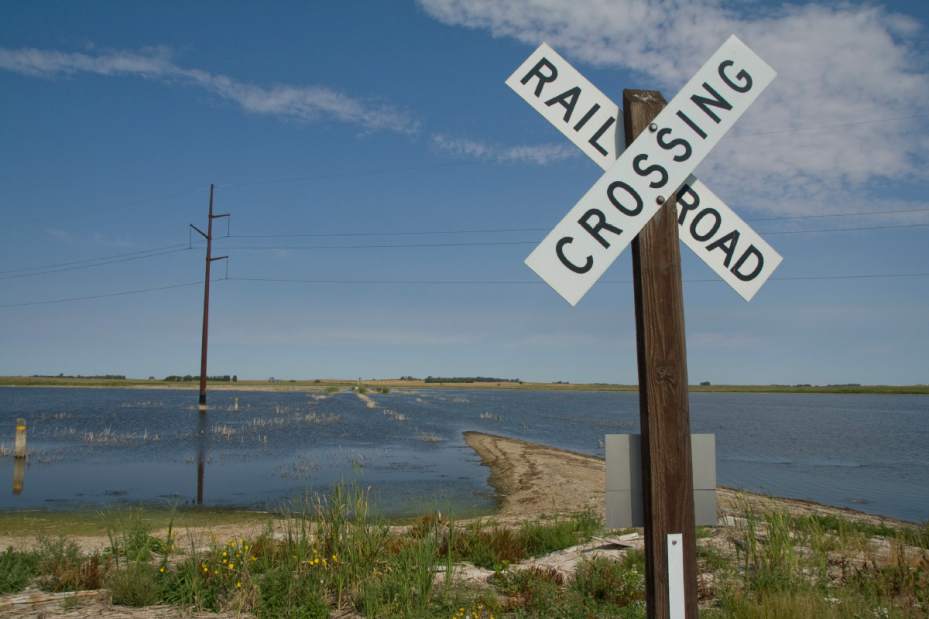
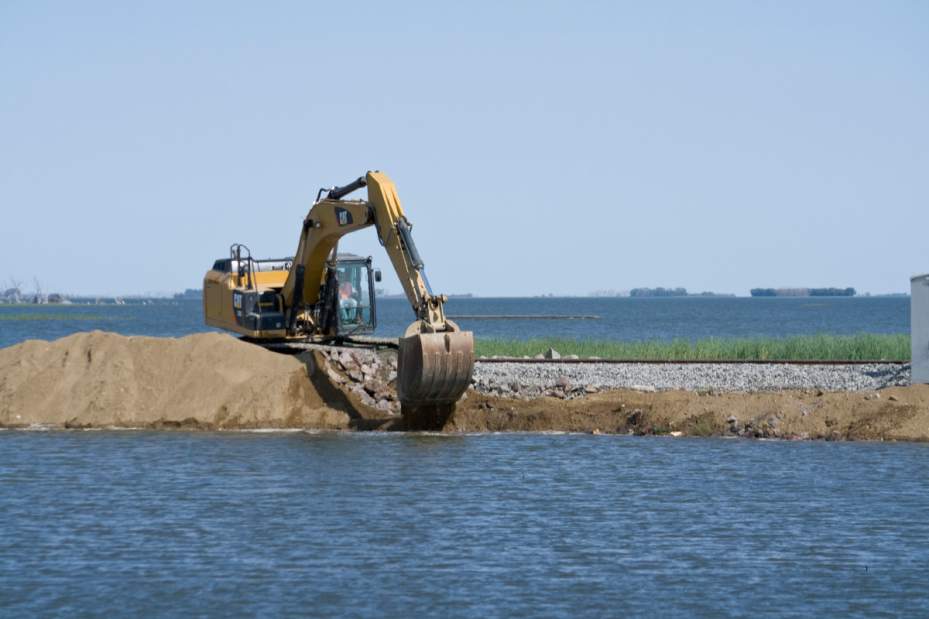
DEVILS LAKE, N.D. — Twin ribbons of iron stretch to the east and west, resting on a miles-long mound of large stones and gravel.
A bucket-loader scoops a pile of dirt and drops it beside the train tracks, into water that stretches to the northern horizon. Not long ago, these tracks ran through some of the country's most fertile farmland — land that was dry since around the time Leif Erikson landed in North America.
But Devils Lake returned to claim it.
Though this flood has attracted little national attention since it began in the early 1990s, the lake's inexorable rise swallowed tens of thousands of acres, hundreds of homes and miles of roadway. It is blamed for 24 deaths, and the battle against it has cost $1.5 billion in federal, state and local dollars, said Jeff Frith, manager of Devils Lake Joint Water Resources Board.
“It's a slow-moving cancer,” Frith said. Because it's slow, there have been no dramatic Coast Guard rescues or rapid currents sweeping away homes to attract national television camera crews, he said.
While most of the country endured drought conditions this summer — from the brittle, burning forests of Colorado to parched swaths of Texas — the 20,000 or so people in this basin endured another year in a wet cycle that happens every 1,000 to 2,000 years. The only way for water to leave the basin is through evaporation or gigantic pumps that came online in recent years.
When the flood began in 1993, Devils Lake covered 69 square miles — about the combined area of Penn Hills, Plum and Monroeville. By last year, it had risen 32 feet and spread out over 327 square miles — an area larger than New York City.
“It really came quick, and a lot higher” last year, said Rick Tofsrud, 62, a farmer who lives north of the town of Minnewaukan. According to the state Water Commission, Devils Lake and hundreds of smaller bodies of water that cropped up over the past 20 years increased in size from 470 square miles to 819 from 2010 to 2011. That rise put about one of every four square miles in the basin under water.
“It took a lot of property,” Tofsrud said.
Minnewaukan used to be eight miles from the lake. Tofsrud moved his mother out of her home there last year, about 10 days before the lake began seeping into her basement.
North Dakota's Department of Transportation spent about $500 million to raise roads above the water. Raising 16 miles of tracks used by BNSF Railway and Amtrak cost $100 million. The government almost entirely bought the town of Church's Ferry, north of Devils Lake.
Towns grew up around the lake based on its previous high of 1,437 feet above sea level, a record set in 1870 when the first Europeans arrived. What the settlers didn't know, though, was that it had been higher at least four times since the last ice age, rising as high as 1,458 feet, when it breached the basin and flowed into the Sheyenne River.
Last year, the lake reached 1,454 feet.
“The way the Native Americans looked at it, you know ... they were a nomadic tribe. So if the lake rose, they just moved the tribe somewhere else, or they moved out of the way of the water,” Frith said. “Obviously, we're not that smart.”
Twenty-four people died in cars that drove off the road into water, Frith said. Around Devils Lake's 1993 boundaries, the water used to be only a foot or two deep. Now, the depth can be 20 feet, he said.
In much of the region — such as the land behind Paulette Anderson's home — the flat geography makes for shallower waters. Beavers and muskrats have taken over the fields where she once kept horses near this sparsely populated stretch of Highway 2.
“The beavers got our trees,” said Anderson, 59. They pulled the felled trees across her submerged field and built a dam on the other side of their property. “I showed our insurance guy one day. He couldn't believe it.”
More than $284 million worth of crops have been lost in Ramsey County, where Devils Lake is located, since 1997, according to crop insurance figures from the U.S. Department of Agriculture.
Tofsrud's farm, once 10 or 12 miles from the lake's shore, now has 60 to 70 acres under water. To maintain his ownership of that land in case the water ever recedes, he continues to pay taxes on it.
Though it does him no good, his land is productive for some. Fishing tournaments have returned to Devils Lake, which holds seven times the water it did in 1993. In one of last year's walleye tournaments, the winner caught the prize fish as it swam over Tofsrud's field.
He offers a little half-smile at the memory.
“That was kind of adding insult to injury.”
Mike Wereschagin is a staff writer for Trib Total Media. He can be reached at 412-320-7900 or mwereschagin@tribweb.com.
