
https://archive.triblive.com/news/florida-marks-milestone-in-everglades-python-control-program/
Florida marks milestone in Everglades python control program

• |
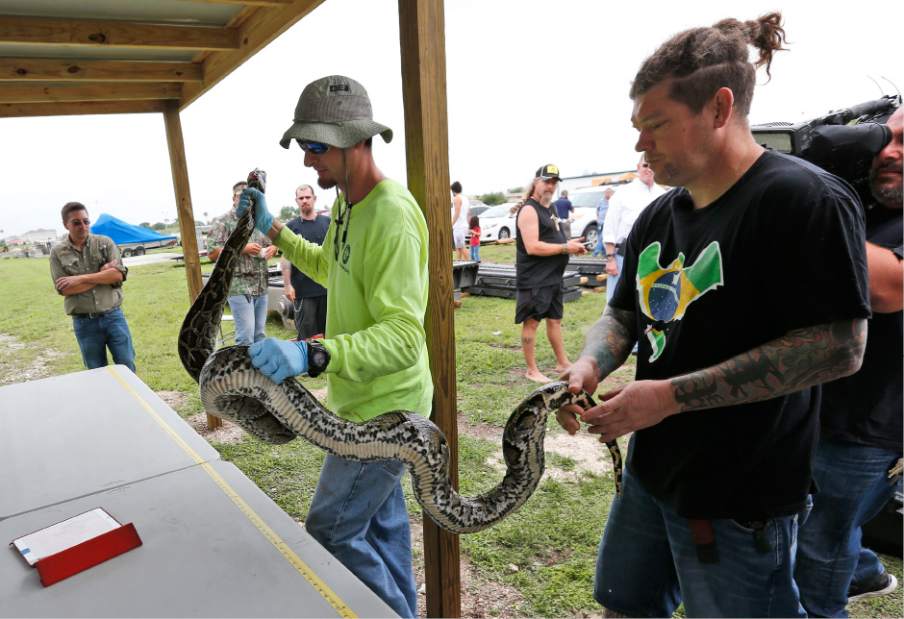
Python hunter Brian Hargrove, right, is helped by Marcos Fernandez, left, with the South Florida Water Management District, as they measure and weigh the 1,000th python caught in the Florida Everglades, Tuesday, May 22, 2018, in Homestead, Fla. The state has been paying a select group of hunters to kill the invasive snakes on state lands in South Florida since March 2017. (AP Photo/Wilfredo Lee)
HOMESTEAD, Fla. — Florida is marking a milestone in its attempt to control an infestation of Burmese pythons in the Everglades.
The state has been paying a select group of 25 hunters to catch and kill the invasive snakes on state lands in South Florida since March 2017. On Tuesday, the 1,000th python collected in that program was measured and weighed at the South Florida Water Management District’s field office in Homestead.
Hunter Brian Hargrove collected the milestone snake just before midnight Friday. He is the program’s most prolific hunter, harvesting over 110 pythons over the last 15 months.
Hargrove said he was driving slowly along a canal and looking through the grass when he spotted the 11-foot-2-inch-long male snake along a levee.
I added a video to a @YouTube playlist https://t.co/WUMrvGZKEB Florida Python Hunters Celebrate 1,000th Capture
— Delta Oracle (@somewheredelta) May 23, 2018
The area also was habitat for American crocodiles, one of the protected native species in the Everglades that officials say are losing ground to the invasive pythons. “Getting it out of there was a good feeling,” Hargrove said. When the program began, Hargrove told The Associated Press he hated having to kill the pythons, but he wanted to help save wildlife in the beleaguered Everglades. On Tuesday, he said he still tries to avoid hunting alone. “I like to hunt with a friend because if we are successful, I don’t like to have put an animal down,” he said. “It’s a beautiful creature. It’s not their fault. But it’s the job.” Half the 1,010 pythons harvested by hand as of Tuesday have been females, which can produce up to 70 eggs each year. People have no business importing exotic species into this country for sale as pets. The Burmese python has since become a plague in southern Florida wetlands after its accidental introduction into the wild sometime during the 1980s. https://t.co/Hqp7nJ09q6— Donald Koelper (@Donald_from_HI) May 22, 2018
“We’ve removed potentially tens of thousands, if you consider their reproductive abilities,” said Mike Kirkland, who manages the ongoing python hunt for the water management district. The hunting program initially was limited to Miami-Dade County but has been expanded into Broward and Collier counties. The snakes brought in have averaged around 9 feet in length, though hunters also have brought in 14-inch hatchlings as well as snakes nearly 18 feet long. “The more they eat, the bigger they get,” Kirkland said. Burmese pythons are non-native, invasive snakes that are creating havoc in the Everglades ecosystem. This graphic shows the potential effect just one python can have on native Florida wildlife. pic.twitter.com/sJkAgXqDdj— South Florida Water Management District (@SFWMD) May 22, 2018
Tens of thousands of pythons are estimated to be slithering through the Everglades. Scientists say the giant constrictor snakes, which can grow over 20 feet long, have eliminated 99 percent of the native mammals in the Everglades, decimating food sources for native predators such as panthers and alligators. Hargrove said the pythons have had a dramatic effect on the landscape he has explored since he was a teenager. “There’s nothing,” he said. “You used to drive in the Everglades and you would see, easily, 20, 30, 40 rabbits on any given morning. I’ve only seen one since starting this program — one, and he looked scared.”Copyright ©2026— Trib Total Media, LLC (TribLIVE.com)