
https://archive.triblive.com/news/garden-qa-growing-under-trees-can-be-difficult/
Garden Q&A: Growing under trees can be difficult

• |
Jessica Walliser
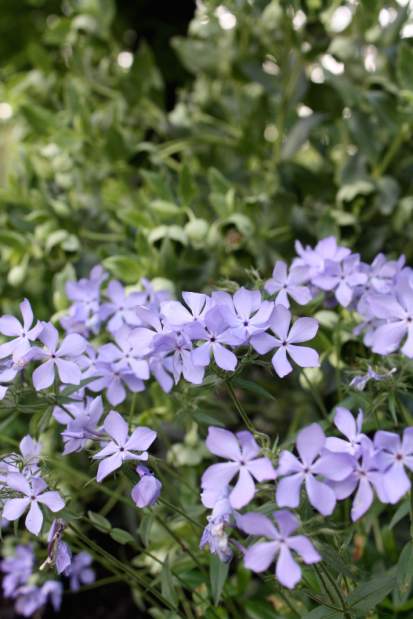
Wood phlox is an excellent perennial for dry shade.
Question: I have four large sugar maple trees on my property, and because of them, the sunlight is limited. What annuals and perennials can I plant under the trees?
Answer: It is extremely difficult to grow under large, established trees. The lack of sun may not be the biggest hurdle you face because the suction power of the root system of a 25-foot-tall tree is staggering.
In a nutshell, as the tree transpires and loses water through leaf evaporation, moisture is drawn out of the soil and into the tree through its vascular tissue. This tissue consists of billions of extremely thin tubes (or capillaries). Water molecules love to “stick” to each other, and as they do, they can climb higher and higher into these tiny tubes and up into the tree’s canopy. The tree does this without using any energy (much like a paper towel sucks up a spill through the tiny channels in its fibers). This force is extremely powerful — a mature tree can draw several hundred gallons of water from the soil every day.
That being said, there are very few plants that can compete with tree roots for water and nutrients. If you find a full-grown tree in the forest, you’ll note that very little is growing beneath it — certainly no grass. But, if you are desperate to give it a go, turn to perennials and groundcovers that can handle dry, shady conditions, or plant a bunch of colorful containers full of annuals and strategically place them under the trees.
Ferns, barrenwort, Solomon’s seal, ajuga, liriope, hellebore, lamium, spurge, lady’s mantle, lungwort and sweet woodruff are all good perennial choices for these growing conditions. All are widely available at local garden centers. Do remember, though, that no plant will survive without water, so you’ll need to ensure they receive at least an inch of water per week during dry periods.
When working with large, established trees, you never want to cover up their roots with loads of topsoil. Tree roots need air almost as much as they need water, and burying them under several inches of topsoil slowly suffocates them. Keep this in mind when you’re planting the perennial border, and add just 1 or 2 inches of compost to the area before you plant.
Horticulturist Jessica Walliser co-hosts “The Organic Gardeners” at 7 a.m. Sundays on KDKA Radio.
Send your gardening or landscaping questions to tribliving@tribweb.com or The Good Earth, 503 Martindale St., 3rd Floor, D.L. Clark Building, Pittsburgh, PA 15212.
Copyright ©2026— Trib Total Media, LLC (TribLIVE.com)