

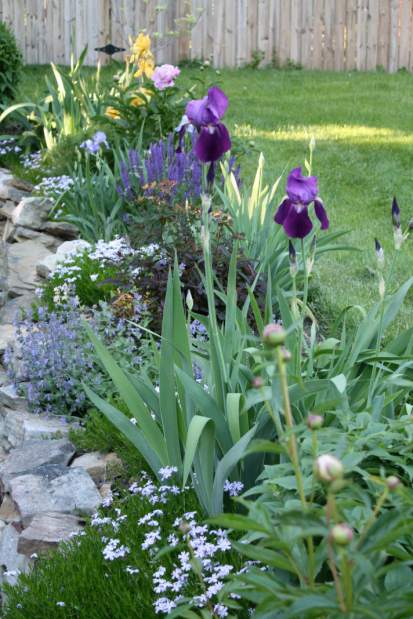
Question: I have inherited a rather overgrown iris and daylily garden from the former owners of our house. The flowers are very pretty but randomly placed and in large bunches. Can you advise me how to move and/or divide some of the irises? They are getting too big. I have ended up with a garden that looks more like a jungle, especially when the plants are done blooming.
Answer: The timing of your question couldn't be more perfect! Nearly every perennial prefers to be divided in early spring or fall (including your daylilies), but July is the perfect time to divide bearded iris. When they finish blooming, use a sharp pair of pruning shears to cut off the dead flower stalks, then carefully dig up any iris clumps you'd like to divide.
Once the clump is out of the ground, use your hands to pull off any brown foliage, then use a clean pair of scissors to cut all the remaining foliage down to about half of its original height. If you can, cut the leaves on an angle to allow water to roll off the cut portion and not puddle on the blunt ends, causing potential bacterial problems.
After the foliage is trimmed, use your hands to crack apart the large, fleshy rhizomes (roots). Make sure each piece of divided rhizome has a healthy fan of foliage attached. You can make the divisions any size you'd like; as long as there is a portion of root and a fan of foliage, you've made a viable division. Keep in mind, however, that replanting very large divisions may mean you'll be dividing them again in two or three years, but you may have to wait a year or two for overly small divisions to come into bloom. Somewhere in between is ideal.
As you work, be on the lookout for iris borers — plump, pale-pink grubs that tunnel through the rhizomes. Squash any that you find.
Replant the divisions in well-drained soil amended with compost or another quality organic matter. You can move the iris divisions to new locations throughout your property or share them with gardening friends. Iris bloom best in full sun. When replanting, be sure the rhizome runs parallel to the soil surface and the top half of it remains above the soil line. Burying the rhizomes too deep will cause them to rot.
Horticulturist Jessica Walliser co-hosts “The Organic Gardeners” at 7 a.m. Sundays on KDKA Radio. She is the author of several gardening books, including “Grow Organic” and “Good Bug, Bad Bug.” Her website is www.jessicawalliser.com.
Send your gardening or landscaping questions to tribliving@tribweb.com or The Good Earth, 503 Martindale St., 3rd Floor, D.L. Clark Building, Pittsburgh, PA 15212.
