

Avid gardeners may already be familiar with a horticultural technique known as grafting. For centuries, orchardists, rosarians, nursery owners and other growers have used this technique to create plants with improved disease resistance and hardiness, increased yields and unique physical forms, and to make fruit trees that bear multiple varieties on the same tree.
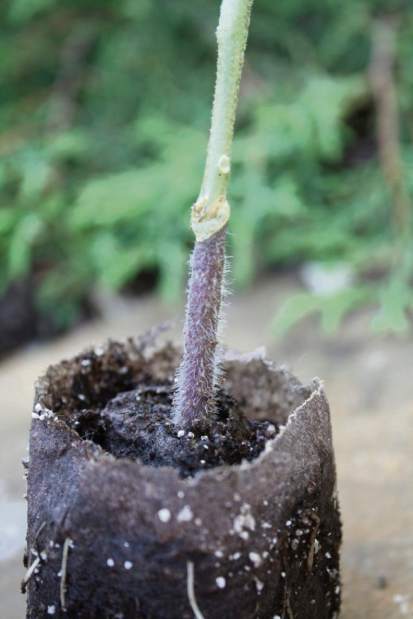
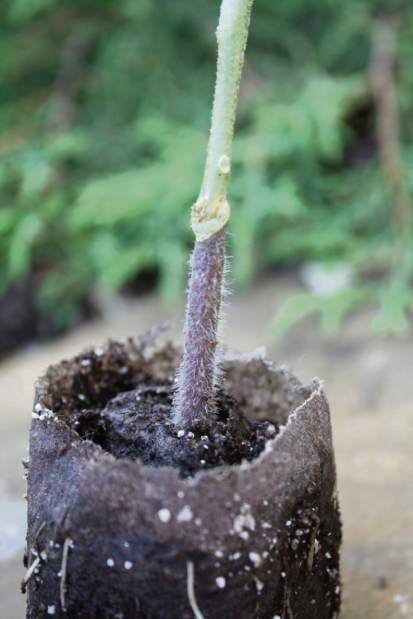
Though there are many types of grafting, in its simplest form, grafting attaches the shoot system (the scion) of one plant to the root system (the rootstock) of a separate plant. The two are grafted together in a fairly simple procedure, and once the graft union has healed, the two plants grow as one.
Grafting allows growers to combine the positive attributes of two varieties into one plant. In most cases, the scion and rootstock must be from the same species (or, sometimes, the same family) in order for them to be compatible and for the graft union to take. In other words, you can't graft a juniper with an oak tree. But, you can graft an apricot with a peach tree because they're in the same stone-fruit family.
The technique of grafting allows us to have dwarf fruit trees (the dwarfing trait is carried in the rootstock), apples that bear five varieties on the same tree, and a “fruit cocktail tree” that grows several types of stone fruit, each on its own branch.
The rootstock selected for grafting is often chosen for the heartiness or disease resistance of that particular variety. The shoot system, or scion, is selected for flower color, fruit production or unique growth form. In the case of a hybrid tea rose, for example, a rose with a gorgeous, fragrant bloom would be grafted onto a rose rootstock variety with improved tolerance for cold temperatures and resistance to fungal diseases. Together, they make a beautiful rose that's disease resistant and tough as nails.
Grafting is quite common among fruit and ornamental trees, especially those with unique or specialized forms. For example, many weeping trees are created by grafting a pendulous shoot system onto a straight-trunked variety of the same plant, and some Japanese maples may be grafted onto different rootstocks to improve their winter hardiness. Novelty pom-pom bushes often are created through grafting as well.
One slightly newer way the technique of grafting has found its way into our gardens is through vegetables. Some seed catalogs carry grafted tomatoes, peppers, melons and other vegetables. Though these plants have been commercially grown in other parts of the world for many years, they're just now finding a home in the United States.
Grafted vegetables are created by selecting a great-tasting, heavy-yielding variety and grafting it to a rootstock with improved disease and pest resistance, early maturity, drought tolerance, and/or vigorous growth. The idea is that these grafted plants will perform better and produce earlier than those vegetables that are ungrafted.
Another new adventure in grafting is the double-grafted tomato (available from Territorial Seed Co., territorialseed.com). These plants have two tomato varieties grafted onto the same plant, meaning you'll get two types of tomatoes from the same plant each with its own branch.
Keep in mind, though, that grafting is useful only for the generation of plants on which it was performed. The improvements made through grafting are not carried to the next generation via saved seeds or even by taking cuttings of the plant. Grafting cannot result in improved progeny like purposeful plant breeding can; it's merely an interesting way to combine the positive attributes of two plants into one.
Horticulturist Jessica Walliser co-hosts “The Organic Gardeners” at 7 a.m. Sundays on KDKA Radio with Doug Oster. She is the author of several gardening books, including “Attracting Beneficial Bugs to Your Garden: A Natural Approach to Pest Control” and “Good Bug, Bad Bug.” Her website is jessicawalliser.com.
Send your gardening or landscaping questions to tribliving@tribweb.com or The Good Earth, 503 Martindale St., 3rd Floor, D.L. Clark Building, Pittsburgh, PA 15212.
