
Hill District redevelopment plan shows great promise


Pittsburgh has had a number of urban-planning disappointments and a few outright disasters over the years.
But it's good to report that the recently released Pittsburgh Penguins' plans to redevelop the Lower Hill District are a clear winner. The Penguins' group has come up with a highly sophisticated preliminary plan that incorporates values that can be important to all of us.
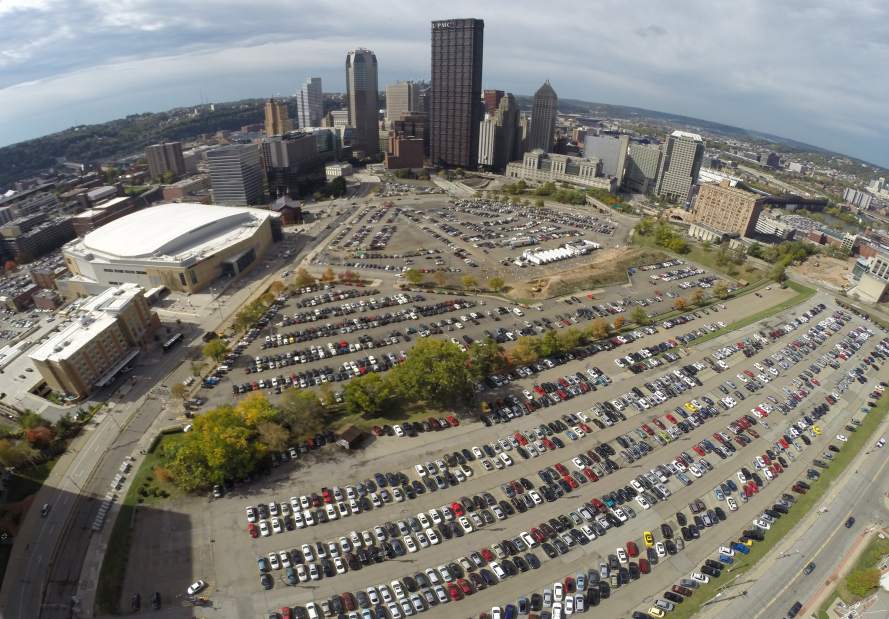
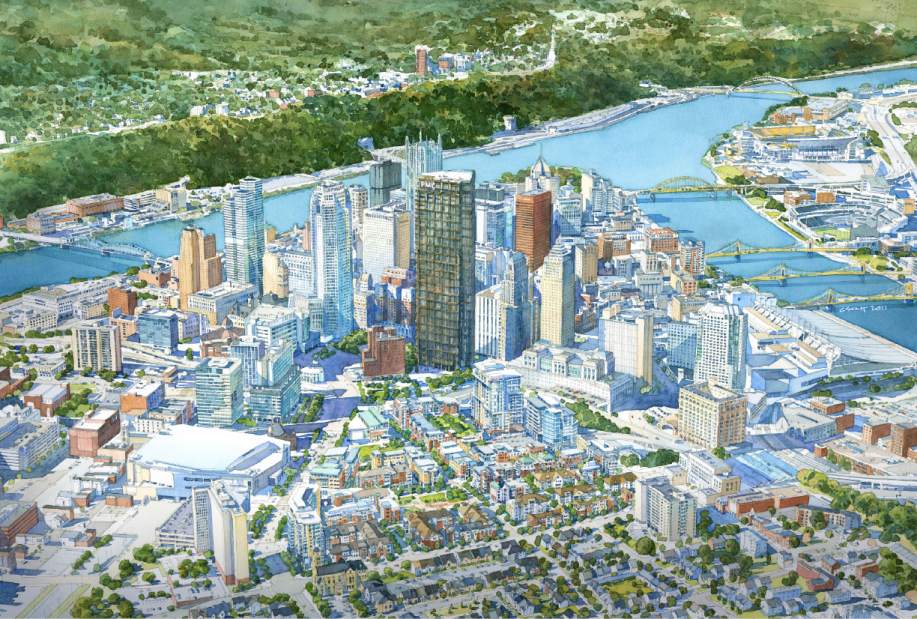
The plans cover a 28-acre tract of empty land next to Consol Energy Center that used to be occupied by the demolished Civic Arena and its seemingly endless parking lots. They take an appropriately conservative approach to a redevelopment that will likely stretch out over a decade or more and will require participation by what may well turn out to be a large number of private developers.
The plans create, in effect, a concept that will guide what the planners are calling the “form, the density and the character” of what developers may do in the Lower Hill, without specifying precisely who will do exactly what or exactly where.
Areas are specified as to the height of buildings, how they will relate to the streets and other factors, but, within those allowances, developers will have considerable flexibility. The development is likely to contain a mix of high-rise and low-rise office and apartment buildings, shops, restaurants, hotels and townhouses.
There are still issues of concern to the nearby communities in the Hill and Uptown — such as the proportion of low-cost housing to be provided, the use of minority contractors and exactly what the height allowances might be for certain important parcels. But after those are settled, the city should move ahead with this plan and resolve to scrupulously maintain it over the years as development proceeds.
Provisions for the buildings themselves, for traffic management and parking, for street and sidewalk design, pedestrian spaces, public amenities and parks — all are exemplary.
The plan even takes into account the views — the vista — that residents, pedestrians and motorists will encounter as they look from the Hill toward Downtown. This is no small matter. Think of how the experience of a baseball game at PNC Park is enhanced by the view of Downtown. There's an even more dramatic view from the streets of the Hill. To preserve it, the plan envisions clustering high-rise buildings to two sides of the funnel-shaped development and low-rise to the middle streets.
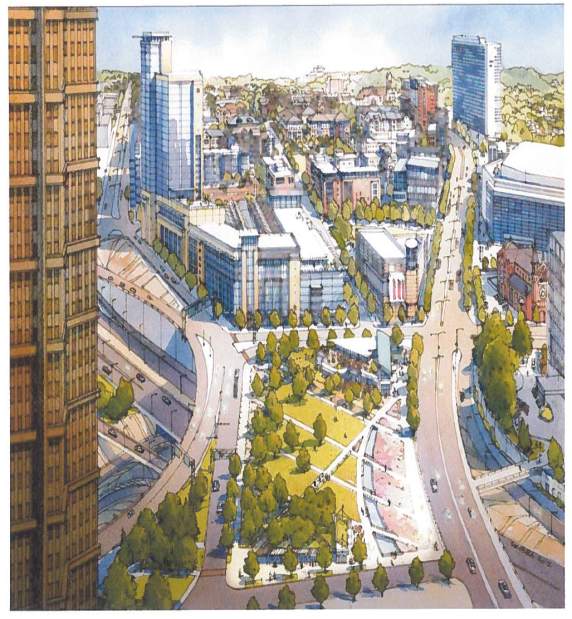
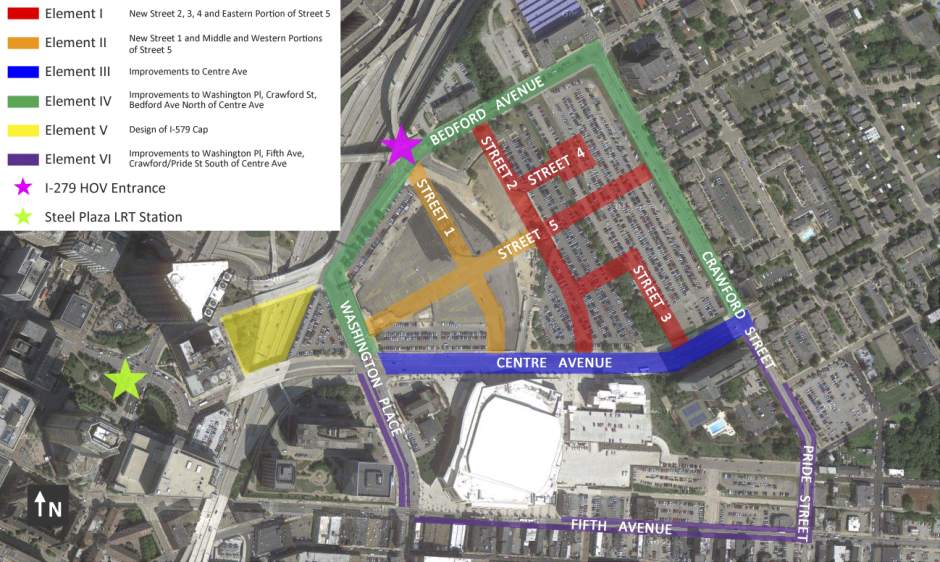
Another key feature of the plan is a re-creation of the urban street grid on the site. It provides for reconnection to the streets of the upper Hill at the top of the plan and to the Golden Triangle at the bottom, integrating people and businesses. The plan recommends building a broad park that will bridge-over part of the Crosstown Expressway (Interstate 579). This may well be an expensive undertaking, but it should not be slighted.
Reconnecting to the Downtown will improve development prospects for offices and stores considerably at the new site, and reconnecting to the existing upper Hill grid should have positive spin-off effects for that long-beleaguered neighborhood, too.
The Crosstown may be a major convenience for many of us, but it has had the effect of fencing off Downtown from the Hill for too many years. That “fence” should become history.
Unlike in so many recent Pittsburgh-area developments, parking lots will, refreshingly, be mostly out of sight under this plan. Any parking near green spaces will have to be screened, parking garages will have to follow esthetic guidelines, and parking behind and between buildings will have to be within the inside of any given city block or under buildings.
Despite that, on-street parallel parking will be encouraged along many of the new streets, all of which will have two-way traffic. Both features can add to the feel of liveliness on the streets and, at the same time, slow down traffic naturally.
The plan goes into great depth in describing the character of the new streets to be built — their size, their landscaping, the sidewalks and the degree of slope on each. It also envisions strictly pedestrian connections in several locations.
Low-rise residential areas are contemplated along Crawford Street, at the highest point in the development, near Crawford Square, an existing Hill District residential area.
The plans were produced locally by Urban Design Associates, a Downtown firm that is often hired to do city planning not just in the United States but around the world. They have truly given Pittsburgh a world-class design. LaQuatra Bonci Associates, the high-quality local landscape-design firm, and Trans Associates, which specializes in traffic planning, were partners.
Their plans, if hewed to and executed over time, will reintegrate and reconnect the city and the Hill, undoing a divide that should never have occurred, and will make the Lower Hill a vibrant accessory to the center of our city.
John Conti is a former news reporter who has written extensively over the years about architecture, planning and historic-preservation issues.
