

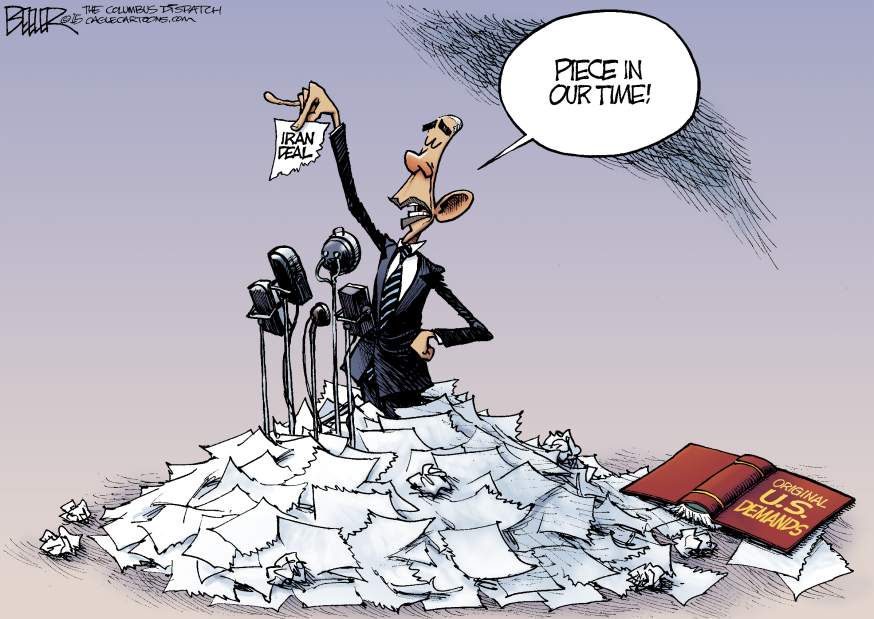
The Heritage Foundation's James Jay Carafano is a leading expert in national security and foreign policy challenges. He spoke to the Trib regarding the agreement announced Tuesday between Iran and six global powers, including the United States, that theoretically limits Iran's nuclear capabilities.
Q: A lot of people are calling this a historic deal. Do you agree?
A: You know, the Kellogg-Briand Pact was historic, the Munich Pact was historic, the Versailles Treaty was historic, the Paris peace talks were historic — but they all utterly failed to prevent really bad things from happening. People say this agreement is historic. I don't think it's big news.
Q: What are your chief concerns with the agreement?
A: The first one is this could well lead to a regional arms race. Regardless of (the deal), it is very clear that none of the surrounding countries believe they have thwarted Iran's nuclear capability and they see a nuclear-armed Iran as having a strategic advantage over them, and that's unacceptable.
Nobody believes that Turkey or Saudi Arabia or Egypt are not going to feel threatened by this deal. We already are seeing them (engage in) a conventional arms race; (now) we could well see a nuclear arms race.
Q: What about President Obama's assertion that the deal cuts off every pathway to an Iranian nuclear program?
A: Regardless of what the administration says, Iran maintains a nuclear breakout capability because it maintains a vast infrastructure and not just in nuclear processing; it still has the capability to be in a nuclear breakout state.
So (Obama) states, “Well, we blocked their path to building a bomb.” No, you haven't.
It's like saying, “Well, I stopped an alcoholic from driving because he promised me he wouldn't drive.” But he still has a car, the car is still full of gas, he still has keys and a driver's license, right?
Q: How does Iran benefit from the accord?
A: You're going to give them $150 billion worth of sanctions relief on top of the oil sales, on top of the stimulus to the economy, so you are going to funnel something like $300 billion to the Iranian government. The money is not going to the people. Iran is a kleptocracy, so the money will be siphoned off to strengthen the Iranian regime, better enable it to oppress human rights, enable it to fund a very aggressive foreign policy for destabilizing the region for Hamas and Hezbollah and the Houthi rebels in Yemen, the Shiite militias in Iraq and Assad in Syria.
So, you're empowering the regime and really not getting anything in return.
Then there's the fact that this deal is just temporary. You know, people say it's for 10 years but it doesn't have to last 10 years for the Iranians. Maybe it will just last two years and they get $100 billion and they are fine and then they say, “Screw this deal.”
Even the administration, in its most optimistic assessment, says it's provided a temporary measure. And if it's temporary, what's supposed to happen (long-term)? Something else is supposed to come along and make it all good? What is that? The administration has no idea.
Q: Overall then, would you call this a clear victory for Iran and a clear defeat for the United States and the other nations signing the treaty?
A: Yes. And I would say the Iranians see it that way as well.
Eric Heyl is a Trib Total Media staff writer. He can be reached at 412-320-7857 or eheyl@tribweb.com.
