

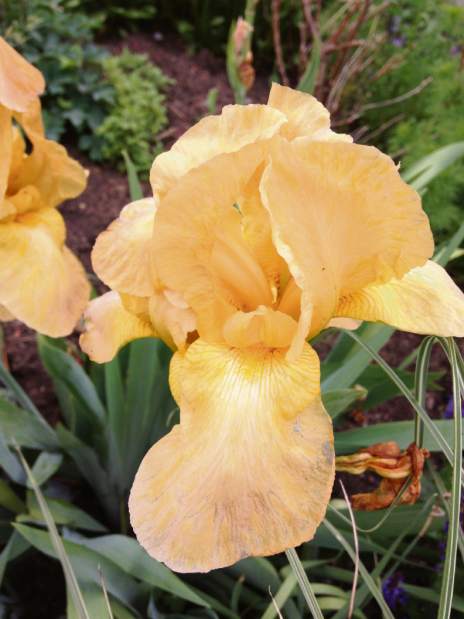
Question: I have a lot of bearded iris in my garden, and they bloom beautifully in the spring. But then by the time July rolls around, the leaves get yellow and slimy. There are brown patches on the leaves and the entire plant smells bad. Do I have iris borers? If so, how do I get rid of them?
Answer: Though bearded iris are gorgeous spring bloomers, there's no doubt that an infestation of iris borers can turn this beautiful plant into an icky mess by late summer. It does indeed sound like your plants are being attacked by iris borers.
The caterpillars of a species of moth (Macronoctua onusta), iris borers feed only on the leaves and rhizomes of iris plants. Adult moths fly around the garden at night, seeking their host plants. When a female moth finds an iris plant, she lays eggs on the leaves, usually in August or September. The tiny eggs sit on the leaves all winter long, waiting until the following spring to hatch.
Soon after hatching in early spring, the miniscule caterpillars burrow into the newly emerged leaves and spend weeks feeding inside of them. Over the course of the spring and early summer, the caterpillars make their way down toward the base of the plant. By the time July arrives, the borers have reached the rhizomes and they begin to feed on these fleshy roots.
The yellow, slimy leaves covered with brown patches are the result of their feeding. Eventually, these damaged leaves will turn completely brown, shrivel up and fall off the plant. Severe infestations can kill entire rhizomes and impact the following year's flower production.
The unpleasant odor you detect when working with borer-infested iris is the result of the rhizomes rotting after the borers have tunneled through them. The smell is much like that of rotten potatoes or onions.
When early August arrives, the caterpillars are mature and ready to pupate. They exit the rhizomes and form an underground chrysalis. They pupate into a new generation of adult moths a few weeks later. Soon after that, they begin to breed and lay eggs on more iris foliage.
The simple trick to controlling iris borers is to cut the plants down completely in late fall and clean the trimmed leaves out of the garden entirely. Because the eggs overwinter on the foliage, it's important to get all the foliage out of the garden. Cut each leaf all the way back to the rhizome and toss it into the garbage. Do not put the leaves in the compost pile. This process is best completed soon after we get a few hard frosts and the adult moths have stopped laying any more eggs.
Because your iris plants are already infested with borers, you can also dig them up and destroy any borers you find inside. Use a pitchfork or shovel to lift your iris clumps out of the ground and crack apart the rhizomes, seeking out the fat, pink caterpillars housed inside. Toss any soft or rotted rhizomes right into the trash and replant only the healthy ones. When you find a borer, squish it or put it into a jar of soapy water (our chickens are very fond of eating them!).
If you neglect to trim back the foliage in the fall, you can also apply beneficial nematodes (species Heterorhabditis or Steinernema) to your iris plants in the spring. These microscopic roundworms tunnel around the plant, seek out the immature borers and kill them. They typically come as a granular product that's mixed with water and sprinkled over the plants. It's best to do this when the iris leaves are fully grown but the plants have yet to develop flowers. You can buy these beneficial nematodes from online sources such as Planet Natural (planetnatural.com) and Peaceful Valley Farm Supply (groworganic.com).
Horticulturist Jessica Walliser co-hosts “The Organic Gardeners” at 7 a.m. Sundays on KDKA Radio with Doug Oster. She is the author of several gardening books, including “Attracting Beneficial Bugs to Your Garden: A Natural Approach to Pest Control” and “Good Bug, Bad Bug.” Her website is jessicawalliser.com.
Send your gardening or landscaping questions to tribliving@tribweb.com or The Good Earth, 622 Cabin Hill Drive, Greensburg, PA 15601.
