

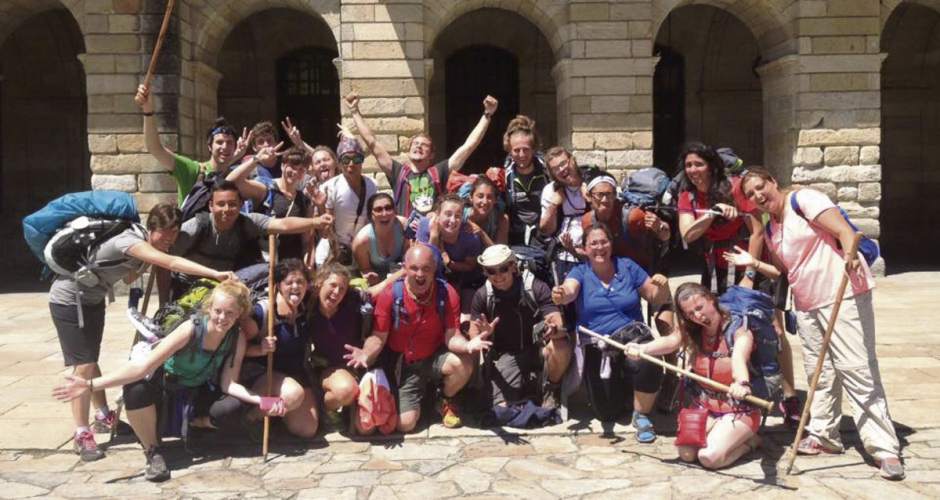




Two local Indiana University of Pennsylvania students recently took advantage of an overseas opportunity to study, but not within the walls of a foreign school. Angelica “Jelly” Cera of Tunnelton and Rebecca Hilditch of Indiana traveled 500 miles across Spain via the Camino de Santiago, a pilgrimage route taken by thousands of people each year.
The pair signed up for the three-credit interdisciplinary course “The Road to Santiago,” which covers aspects of history, literature and art history. Led by IUP history professor Caleb Finnegan, 14 students began their journey in mid-May at the border of France and proceeded to the city of Santiago de Compostela, the capital of the autonomous community of Galicia in Spain. Once at their destination, class members walked an additional three days to reach the Atlantic Ocean before catching a flight home June 27.
It was the fourth time Finnegan has guided groups aong the pilgrimage route. He's planning the next trek for 2017.
Cera, a junior speech and language pathology student, and Hilditch, a sophomore biology/pre-med major, are both students in IUP's Robert E. Cook Honors College. They found out about the “Road to Santiago” through honors classes taught by Finnegan. Students are required to submit applications through the university's Office of International Education to take the course. They also have to complete an interview with Finnegan.
“I took Spanish all through high school and really loved the language and liked the idea of being able to put it to use,” said Hilditch.
“I've never been much of a hiker, but I really wanted to see Spain, and this seemed like the way to do it,” said Cera. “I thought this was a way to see Spain and get the class experience without actually going to a university in Spain.”
The trip wasn't simply a long walk through a foreign land. “It's not only a physical experience, it's also an academic one,” said Finnegan, who gave lectures intermittently. A class session was held each evening, and students were required to give presentations and write journal entries throughout the journey.
In the four trips he's taken, Finnegan said he's encountered very few mishaps. Most setbacks were because of physical injuries.
“It's one thing to put on some nice shoes and walk 16 miles a day; it's another to do it every day for five and a half weeks,” he said, “When you're brutalizing your body every day like that, that also brings emotional toil.
“It's not just a good time, not just walking around every day. There's something to be said as to the value of the difficulty of this particular experience.”
To prepare for the intense walking the trip would involve, the students went on three practice hikes beginning in April along area trails, working from eight miles up to 20 miles.
“In all honesty, I knew the walking would be happening,” said Hilditch. “But it wasn't something any of us really thought about until we started our practice hikes. We had pushed it to the back of our minds almost.”
According to Finnegan, the pilgrimage of Camino de Santiago is over 1,000 years old. “For hundreds of years, Catholics of Europe took this pilgrimage as part of their spiritual calling,” he said.
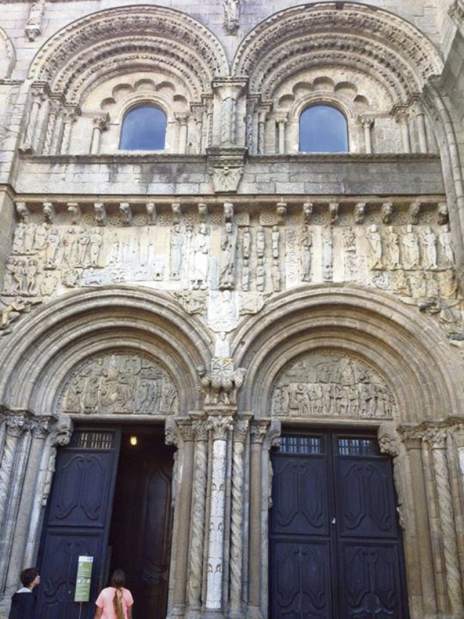
Also known in English as the Way of St. James, the estimated 500-mile journey is based on the belief that the bones of St. James the Apostle are buried in northwestern Spain. Allegedly, his final resting place is the Cathedral of Santiago de Compostela.
“If you go behind the altar, there's this little window you can look into and there's a crypt,” said Finnegan. “According to the people of Santiago, the bones are in there.”
The route has become a bit more secular since the 1960s, Finnegan pointed out, with people from all over the world taking the journey.
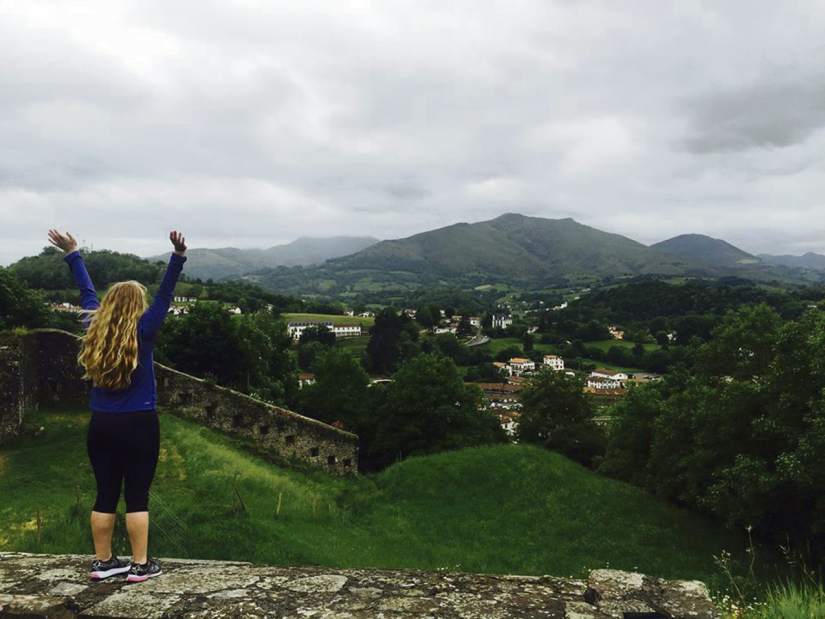
The IUP students' journey started with one of the most difficult sections of the Camino, crossing from the small French village of St. Jean Pied-de-Port over the Pyrenees Mountains into Spain. Fog and rain added to the challenge. “The fog was so bad you could not see three feet in front of you,” Hilditch said.
Some of the major Spanish cities the students encountered were Pamplona, Burgos in central Spain, and Leon.
The route is well marked for pilgrims, with either a yellow arrow or an image of a scallop seashell, an item found in abundance on the shores of Galicia. Each pilgrim is given a seashell at the beginning of the journey, distinguishing them from other travelers.
“It was unbelievable how much the terrain changed,” from the steepness of the Pyrenees to hot, flat mesas, said Cera. “We didn't get bored walking because it was always changing.”
A typical day on the Camino begins at one of the route's many albergues — hostels meant specifically for pilgrims, some holding up to 100 beds in one room.
Carrying their belongings in lightweight backpacks, the students would start walking at about 6:30 a.m. and pick up something to eat at a cafe or bar. Covering an average of 16 miles per day, they typically would reach their next overnight stop by mid-afternoon.
Hilditch said she started every morning with a dose of ibuprofen and made sure to keep ahead of her blisters and foot pain, “Taking care of yourself was really essential,” she said.
Many students washed their clothes or took a nap before their class, held daily around 6 p.m.
Though Finnegan encourages students to immerse themselves in the Spainish experience, the journey has an international flair to it, including the various foods found along the trail. The majority of the restaurants and cafes had separate menus for pilgrims with dishes loaded with carbohydrates and proteins to keep up their energy.
Finnegan pointed out that the class generally didn't walk together as a group, as the students traveled at their own pace. Often, they found themselves joined by other pilgrims. By the time the class reached its destination, three Spaniards, a South Korean and another American had fallen into step with the group.
“It was really incredible,” said Hilditch. “There were so many other pilgrims on the trail. We made a lot of friends.
“We didn't have any bad experiences, The pilgrims are all pretty much always respectful of each other.”
“It's one thing to experience the Spanish culture, but you also get a lot of other cultures, too,” said Cera. “The Camino was part of Spain, but at the same time it's part of the world.”
While English is widely spoken along the Camino, Finnegan, who lived in Spain for two years and in Bolivia for one year, served as the trip's primary translator.
“It was beautiful,” Hilditch said of the Spanish sites the students got to see. “The cathedrals in some of the major cities were unreal, the detail and the amount of effort that it must have taken to build them. We were all just in shock the first time we saw one.”
One of Hilditch's favorite parts of the journey was a stop in a Spanish town that was holding a Renaissance fair, with jousting and vendors.
“It was cool to see how the Spanish culture celebrates things,” she said. “It was probably one of my favorite days because I felt like I was really immersed in the culture.”
A memorable moment for Cera was visiting the Cruz de Ferro, a large, iron cross located between the towns of Foncebadón and Manjarín. The cross is surrounded by a hill formed from mementos left by pilgrims over hundreds of years.
The students were told to bring something to leave at the Cruz de Ferro. Cera brought a lump of coal and a pine needle, representing Indiana County's energy and Christmas tree industries.
For Cera, the Spanish experience that stands out was the trek into Santiago itself, which a large portion of the class completed together. “It seemed like we were a force to be reckoned with,” she said.
Finnegan ensured that students got to experience one of the daily pilgrim Masses held at the Cathedral of Santiago .
“It's a pretty powerful experience,” he said. “You're working for five and a half weeks toward this destination. There's something very satisfying about that feeling.”
“The church in Santiago was definitely an experience in itself,” said Cera. “Unlike other big cities we were in, I was very comfortable in Santiago. I'd wander over in the evenings and just spend time in the cathedral.”
Cera acknowledged that her biggest regret was not committing more of her impressions to the pages of her trip journal.
“Life is so simple” on the trail, said Cera. “I have to walk, I have to eat, shower, take care of my feet. You know what you're going to do each day, yet it's very different. It really taught me to live in the moment. It's about taking the time and enjoying it.”
“Life becomes very simple on the pilgrimage,” said Finnegan. “There seems to be a gradual appreciation for that simplicity. Most students are constantly inundated with information and technology and busyness — we're a society that's built on these things.
“There's something beautiful and primal and very satisfying about living that simple life for five and a half weeks. I think they learn a lot about themselves and about life in general.”
Gina DelFavero is a staff writer for Trib Total Media. She can be reached at 724-459-6100, ext. 2915 or gdelfavero@tribweb.com.
