





Just over 50 years ago, schools were different. Students were different.
It's easy to forget that so much of what is taken for granted and accepted as ordinary today was not in the 1960s.
As the Kiski Area School District prepares to celebrate its 50th anniversary this week, it can be helpful to step back for a moment and realize those differences to better appreciate what began in 1962.
Students didn't ride buses to school; they walked. They didn't eat lunch in cafeterias; they went home. They studied in much smaller schools, there were a lot more schools, and many districts did not operate their own high schools.
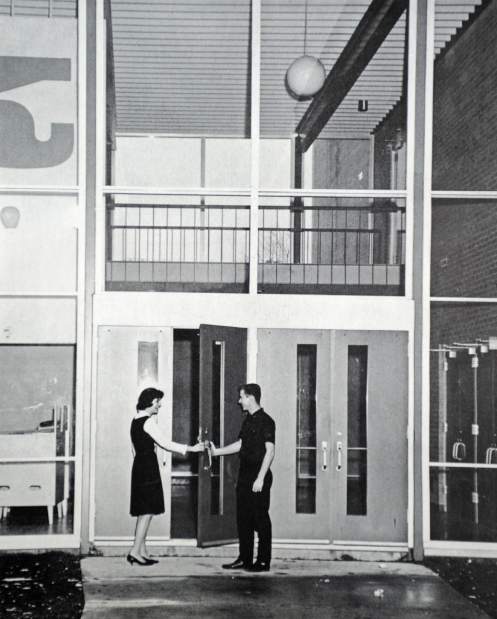
That changed on Sept. 5, 1962, when the new $4 million Kiski Area Senior High School opened its doors to about 1,300 students in 10th through 12th grades who, according to their yearbook, were “eager but bewildered.”
The students were told that was where they would go to school, so that's where they went, said Toni (Bione) Pellegrini, who was vice president of her junior high class at Vandergrift Area High School before becoming a member of Kiski Area's first graduating class.
“We were all excited about a brand new building. I attended the high school both of my parents had attended, not that there was anything wrong with that. It had been there forever,” said Pellegrini, 66, of McCandless. “The idea of a new high school and larger group was also something we really looked forward to.”
Her counterpart at Bell-Avon Joint High School, David Donaldson, vice president of his junior class, would become president of Kiski Area High School's first senior class, despite coming from the smaller school.
“Everybody seemed to get along well. We were all in the same boat. Everybody helped everybody out,” said Donaldson, 67, of Murrysville.
‘A challenge'
The high school was built on what had been the Vandergrift Airport in Allegheny Township, called “the optimum location” in a brochure of the new facility. It opened to serve students from Allegheny Township, Avonmore, Bell, East Vandergrift, Hyde Park, Parks and Vandergrift. Washington Township wouldn't join the district until four years later.
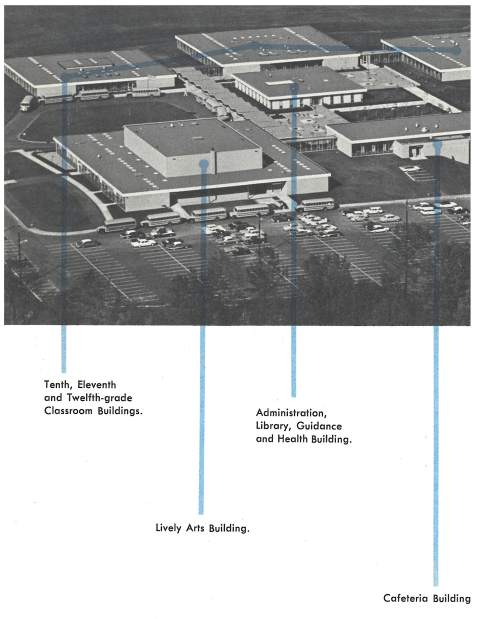
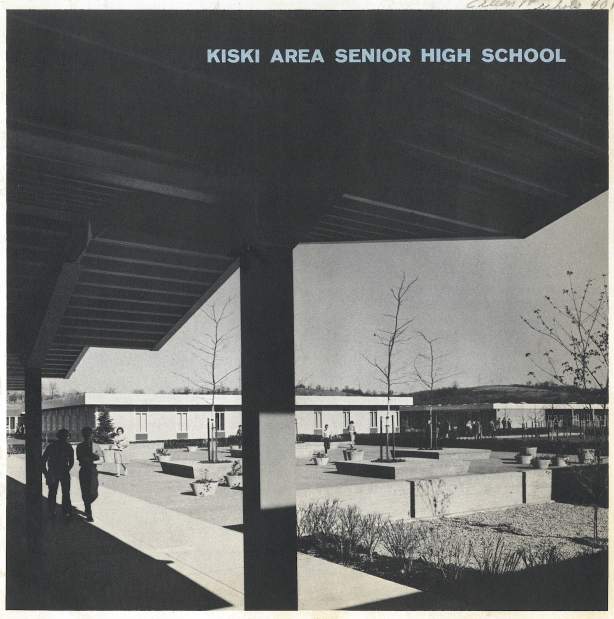
Consisting of seven buildings grouped around a central courtyard, the campus-style school was nothing like the Vandergrift and Bell-Avon high schools it replaced.
“It was like going to a college campus,” said Eileen (Nichols) Eshelman, 67, of Hyde Park, a member of the Class of '63 who lived in Allegheny Township. “We were not used to such big, elaborate rooms and halls and lockers. The swimming pool and everything that was there, it was quite nice.”
The new district brought together a large area, today covering 102 square miles.
“All these kids came in from Avonmore and Salina and all the outside districts. We didn't know any of them,” Eshelman said. “We were amazed how far some had to ride buses to get there.”
Cheryl (Gaydeski) Lorenz, a Vandergrift student, wasn't so sure of the place, at least at first.
“I did not want to go there. I wanted to graduate from Vandergrift,” said Lorenz, 66, of Leechburg. “Once I was there, I was glad. I'm proud to say I'm a graduate of Kiski High School.”
Lorenz remembers that when the band marched for the first time, students were wearing different uniforms.
“It was fascinating to me. It was a challenge. We were doing something different for the first time in our lives,” she said. “We had all new teachers and an all new building. For the first couple of months it was mass confusion. We didn't know where we were going. It was fun, though.”
‘Age of space'
The district owes its existence in part to Sputnik, the Earth's first artificial satellite launched by the Soviet Union in 1957, which sparked school consolidation in addition to the space race.
“Educational opportunities needed to be improved, and Sputnik helped reinvigorate enthusiasm for that,” said Stuart Knade, chief counsel of the Pennsylvania School Boards Association. “It wasn't because they thought they could save money. It was about increasing the educational opportunity.”
That thought appears to be reflected in the high school brochure, which states that a terrestrial-celestial globe in the library “symbolizes the advancement of knowledge in our age of space.”
During the 1960s, as a result of forced consolidations, the number of school districts in Pennsylvania plummeted from 2,277 to 669. There are 500 districts today.
The forced consolidations were made after an unsuccessful first attempt that needed voter approval, Knade said.
“It was not universally popular at the time. There was a lot of resistance to it,” he said.
The discussion leading up to the creation of Kiski Area was a “mixed bag,” said William Miller, who had been a teacher and basketball coach at Vandergrift High School. After a sabbatical, he became a guidance counselor at the new high school. He went on to be a principal and administrator before retiring in 1991.
While living in Monroeville, Miller remains involved in the district as president of the Kiski Area Education Foundation.
The towns that lost their high schools — Vandergrift in particular — were not happy, Miller said. Washington Township, which also wanted to keep its school, remained unhappy when it joined in 1966, he said.
“The whole concept of mergers was highly controversial. A lot of people did not like that because they lost their home schools. People were questioning, ‘Why do this?'” he said.
Miller was among them — at least at first. Happy at Vandergrift, he said he didn't see the consolidation coming and wondered where he'd fit in. In retrospect, he says it was great for him and the students.
The new high school was big enough to offer students more, but not too big for personal attention, Miller said.
“Washington Township, after they came in, realized they did not have the curriculum that could be offered,” he said. “You have to have enough people to have a competent curriculum.”
‘It worked'
Miller said it took a few years for the new district to solidify. He credits the students.
That first year went well, but it was a big adjustment for everyone, he said.
“The kids were pretty mature in absorbing all these changes. I don't remember many complaints. They handled the situation very maturely,” Miller said. “I call them the pioneers.”
As a student, Pellegrini said she didn't know about opposition to the new district, or she just didn't pay attention to it. She went on to be a teacher and a lawyer.
“What I remember is everyone seemed pretty happy about this,” she said. “It was handled well. From the top down, they made an effort to make it work.”
The first student handbook for Kiski Area Senior High sought to set differences aside. A message from Principal Harold J. Bush said all those occupying the new school “should feel a new loyalty which will transcend school district loyalties of the past. Such loyalty will recognize our common interests and contribute to a school spirit which will unite us for the common good.”
Donaldson said students worked together to choose a mascot, colors and a class ring.
“Everybody came together for the most part. As far as I remember, there were no animosities between the groups. We never played each other in sports. There were no rivalries there,” said Donaldson, who worked as a technician for AT&T for 37 years before retiring.
Most of the students saw the change as a fun adventure, Pellegrini said. The joining resulted in friendships, relationships and marriages that otherwise might not have happened.
“It gave all of us more opportunities,” she said. “It worked.”
‘We're all Kiski'
Fifty years later, the effort to make Kiski Area one district can be described as ongoing. And it may happen with the renaming of buildings.
With the opening of a new school for all fifth- and sixth-grade students planned for the 2013-14 school year, the district is poised to close three of its seven elementary schools. Two of the old high schools, Bell-Avon and Washington, that were junior highs before becoming elementary schools, are among them. Laurel Point is the other.
The district will be left with three K-4 primary centers that may shed their old town names.
Vandergrift Elementary would be Kiski Area East Primary Center; Allegheny-Hyde Park would be Kiski Area North Primary Center; and Mamont would be Kiski Area South Primary Center.
The new names aren't a done deal but have been used in paperwork given to the state, Superintendent John Meighan said
With the schools' attendance lines being redrawn to take in more municipalities, the buildings need new identities, said Meighan, a Kiski Area graduate.
“Nobody is going to be a guest in somebody else's school,” he said. “We're all Kiski.”
Brian C. Rittmeyer is a staff writer for Trib Total Media. He can be reached at 724-226-4701 or brittmeyer@tribweb.com.
