

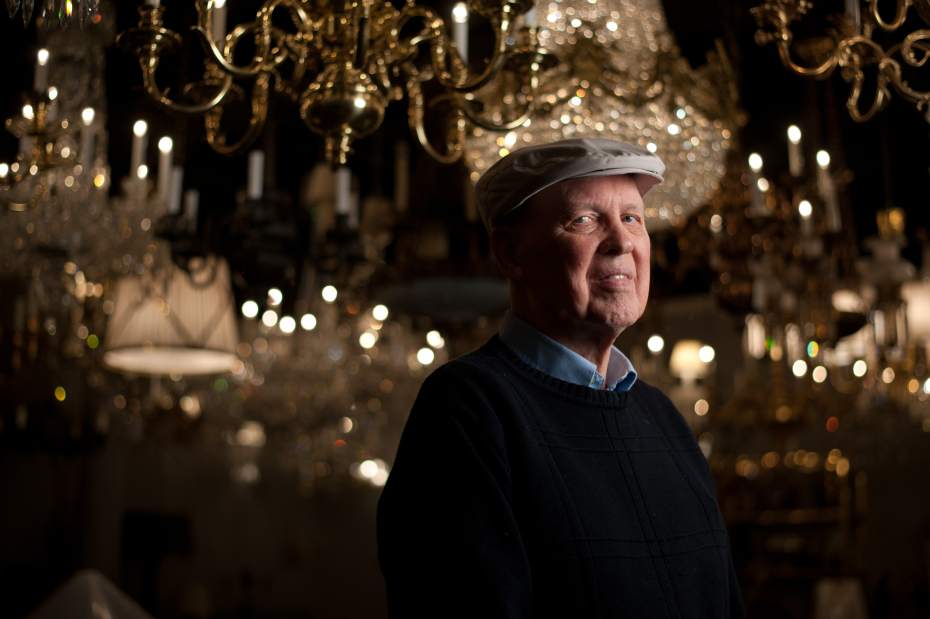
When Francis Nowalk drives down Fifth Avenue these days, he can be reminded of his life's work in just about every block.
Rodef Shalom Temple on the right, Central Catholic High School on the left, then St. Paul's Cathedral, Heinz Chapel, the Cathedral of Learning, the Pittsburgh Athletic Association, Schenley Hall, the Concordia Club, Soldiers & Sailor's Memorial — all of them are places where his work can be found.
For more than six decades, Nowalk has run a decorative and architectural metals firm, now situated in Bloomfield. And, as a craftsman, he has contributed to all of these and many other of the most prominent buildings in town, building or restoring brass doors and railings, architectural trim, and — his specialty — light fixtures and chandeliers.
Most recently, he did architectural lighting and restorations of original fixtures for PNC's renovation of the old Mellon Bank Building at 500 Smithfield St., and his work is visible inside and outside at places like Heinz Hall, in the restored courtroom at the Allegheny County Courthouse, and in the gates, railings and doors he built for the Frick Art Museum in Point Breeze.
As any architect will tell you, all projects these days require a team — not just the architect, but engineers, interior designers and quality craftsmen. And the last is where Nowalk, now 85 and still going strong, fits in. Tall, active and affable, the gray-haired Nowalk works regular 10-hour days and posts newspaper articles on the walls of his busy workshop that tell about factory owners and craftsmen who work into their 90s. That's clearly his goal.
He and the six craftsmen who work for him do a tremendous variety of metalwork. At Rodef Shalom, he restored the huge chandeliers in the sanctuary. At St. Paul's, he crafted new lighting for the sacristies and refinished the old brass tabernacle. At Heinz Hall, in addition to restoring the chandeliers there, he used the tops of old lamp posts that had been removed from the West End Bridge, and refashioned them into the exterior sconces that light the building along Penn Avenue.
He collects many old structural artifacts — gates, railings, metal screens and light fixtures, and often refashions them into tables, table lamps and chandeliers. His workshop on Liberty Avenue has three warehouse floors stacked with artifacts collected over the years.
“I've always been so busy that the stuff just accumulates,” he says. The lamp posts from the West End Bridge had sat in the back of his shop for 10 years before he found use for them at Heinz Hall. His clients — some of whom like to come and rummage through his collections — are primarily architects and interior designers or decorators, though he is quite willing to deal with individuals, too.
He currently is constructing a new showroom right next to his workshop to display the more than 200 chandeliers, tables and the like that he has for sale. He sells mostly locally, but feels the Pittsburgh market is too small for everything he has to sell, and so he's now contemplating ways to sell over the Internet.
And he's also working right now on a furniture project — custom-producing brand-new dining-room tables fashioned to his design from polished stainless steel and glass. Reminiscent of the famous, curved Barcelona Chair designed by modernist architect Mies van der Rohe in the 1920s, this new creation is called the Pittsburgh Table, partly because its supporting curves are similar to the pattern made where the two lenticular trusses of the Smithfield Street Bridge meet. Though minimalist in design, the tables are meticulously crafted from solid, 1-inch by 2-inch stainless-steel bars and a three-quarter-inch-thick glass top. They sell for $15,000 apiece.
Nowalk's employees are all highly skilled, too. One has worked with him for 45 years, another for 42. “New” in his shop is one who has been there 12 years. Though they do much of the work, Nowalk admits he still finds himself working with his hands on the artifacts he collects.
“I'll tell my wife I'm coming in on a Saturday to work on the books, and, then, I'll see a piece of something that I like, and I'll go to work on it,” he says.
Nowalk opened his firm in 1948, setting up shop in his mother's basement in Carrick while still a junior at Duquesne University. In high school, starting at age 14, he had worked summers and part time the rest of the year at the old Argo-Lite Studios on Seventh Avenue, Downtown, eventually learning everything there was to know about hanging and maintaining chandeliers.
Today, he can look back with satisfaction at a decades-long career, six children (two of whom are artists), 20 grandchildren and five great-grandchildren.
“I like to build things. I like the excitement of working with my hands. It's a love,” he says.
John Conti is a former news reporter who has written extensively over the years about architecture, planning and historic-preservation issues.
