

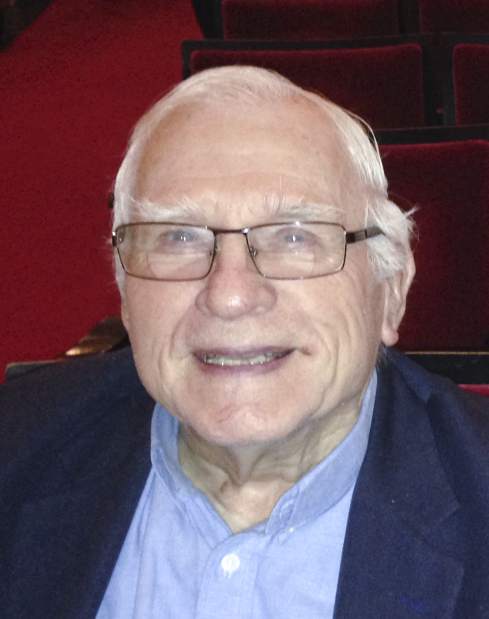
Family road trips with Robert Petsinger only seemed endless.
An engineer who specialized in alternative energy, the Penn Hills native had converted one car, a Pontiac Bonneville sedan, to run on liquefied natural gas, and another, an International Harvester Scout, to run on compressed natural gas, like the kind the comes into a house.
“The downside,” his oldest son, Tom, recalled, “was that it had an 800-mile range, and he never wanted to stop and let us take a leak.”
Mr. Petsinger, 84, died of heart failure Saturday, Feb. 27, 2016. He had been living in the former Roosevelt Hotel, Downtown, his son said.
An early innovator with natural gas, Mr. Petsinger chased most of his adult life after the one big deal that would bring the energy fully into the mainstream and make a lot of money.
He came close to realizing that dream, friends and business associates said. In the weeks before he died, Mr. Petsinger had secured funding for an industrial-sized LNG fueling station and was scouting locations along the Ohio River.
“Things were in better shape when he died than they ever had been before,” said Jim Lewis, administrative vice president of Marcellus Marketing Inc., the company they started.
“He felt it was a value, that it was one of those things that really ought to be done, and that he was the guy who knew how to do it. He enjoyed the interaction and wanted to get the project built.”
Born in Penn Hills, Mr. Petsinger played football at Penn Hills High School and earned the rank of Eagle Scout in the Boy Scouts. He received an academic scholarship to study industrial administration at Yale University, and graduated with a Bachelor of Science in 1953.
Mr. Petsinger earned a Master of Business Administration from Carnegie Mellon University in 1955 and a master's degree in energy resources and management from the University of Pittsburgh in 1975. He completed all of the coursework for a doctorate in environmental systems engineering from Pitt in 1978.
He worked for a time at Westinghouse, U.S. Steel and Crucible Steel before going into business for himself. He founded several companies that included LNG Services in 1968 and CNG Services of Pittsburgh in 1978. His companies built fueling stations for vehicle fleets.
As a side project, he designed the LNG fueling system for The Blue Flame, a rocket vehicle that set a world land-speed record at 630.388 mph on Utah's Bonneville Salt Flats in 1970.
“He was really kind of an innovator and on the leading edge of liquefied natural gas and then compressed natural gas,” said Tim Logan of Fox Chapel, who provided railway advice for the Marcellus project. “He was well before his time.”
In recent years, Mr. Petsinger had traveled to places such as China and Indonesia to talk about natural gas projects. His reputation in the field continued to grow with the rising demand for vehicles powered by natural gas.
“People were always asking him, ‘Why don't you hang it up?' ” said Deniece Teklinski, his longtime companion and travel partner. “And he would say, ‘Because I like what I do.' ”
Mr. Petsinger was preceded in death by his ex-wife, Vicki, in 2005. He is survived by his children, Tom of Portland, Maine, Wendi Steele of Virginia Beach, Va., and Donald of Pensacola, Fla.; a sister, Nancy Petsinger Oliphant; nine grandchildren; and three great-grandchildren.
His remains were cremated. The family expects to inter his ashes in Smithfield East End Cemetery in Squirrel Hill this year.
Andrew Conte is a Tribune-Review staff writer. Reach him at 412-320-7835 or andrewconte@tribweb.com.
