
Parts of Brush Creek nearly uninhabitable due to drainage


It's not difficult to find anglers fishing for carp, catfish and other fish along Brush Creek between Manor and Jeannette.
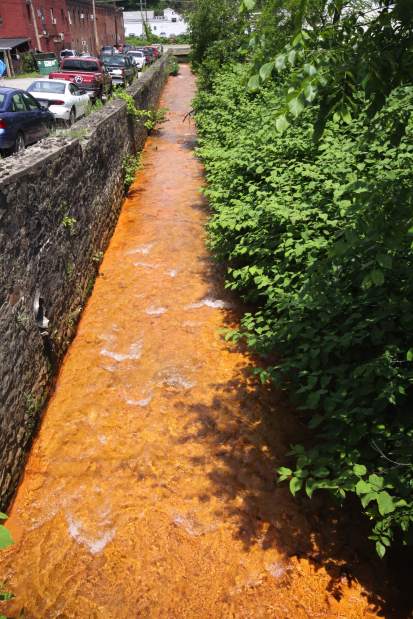
But just upstream, near Irwin, the stream banks are empty and few — if any — fish live in Brush Creek's rust-stained waters.
“The whole way down, there is wildlife, like deer, skunks and raccoons, and fish in Brush Creek where it goes through west Jeannette and Manor,” said Sam Petrill, a member of the Irwin Sportsmen's Association. “But in Irwin, the water in Brush Creek is shallow and, at times, very orange.
“Some fish can adapt and survive, but I would not advise going there as a fishing destination.”
Acid mine drainage from abandoned mines have polluted the water. There are a “vast number” of abandoned mines leaking into Pennsylvania streams, said John Poister, spokesman for the state Department of Environmental Protection.
“We have literally thousands of miles of creek that have been affected by acid mine drainage,” he said.
He estimated that iron and sulfur has been discharging into Brush Creek in Irwin for 30 years.
The rusty hue is the result of an abandoned coal mine, according to Diane Selvaggio, the former executive director for the now-defunct Turtle Creek Watershed Association.
Brush Creek's discoloration comes from pyrite deposits — a mixture of iron and sulfur — leaking into the creek, making it acidic, Selvaggio said.
The Turtle Creek Watershed Association, funded by Duquesne University, closed after the university stopped providing funding, Selvaggio said.
Pennsylvania accounts for the most environmental issues tied to mining and abandoned mines, such as subsidence and contaminated groundwater and streams, of any state in the country, said Andy McAllister, Regional coordinate for the Western Pennsylvania Coalition for Abandoned Mine Reclamation.
Statewide, there are about 4,000 miles of streams impaired by abandoned mine drainage, McAllister said.
Southwestern Pennsylvania is riddled with underground coal mines.
“They needed the coke from coal, and Pennsylvania served as ground-zero for that development,” McAllister said. “Years ago, they didn't have environmental regulations like we have nowadays, and when they were done with a mine, they would just walk away and leave it as it was.”
The region has a high concentration of pyrite, a soft mineral known as fool's gold, along several of its coal seams, McAllister said. When water runs across the coal seams and pyrite, it creates an acidic iron mixture, which mixes with rain and ground water, McAllister said.
“When water fills up the mine, that mixture finds its way out,” he said. “When it's exposed to oxygen, it causes the orange color.”
Along with pyrite, aluminum and manganese also cause water contamination, McAllister said.
Duff Run Creek, which runs parallel to Rodi Road in Penn Hills, Selvaggio attributes its milky blue discoloration to dissolved aluminum deposits. Aluminum is the most common metal found in the Earth's crust, and can be found in most compounds, she said.
When aluminum mixes with the water, it often changes its color to a milky white, blue or green, Selvaggio said.
“The aluminum is most dangerous to fish and other stream creatures when it is completely dissolved, even when the water looks clear,” Selvaggio said. “Trout, for example, will suffer serious gill damage.”
Although Brush Creek and Duff Run Creek are discolored, mine drainage does not always discolor the water, Selvaggio said. Sometimes contaminants, including aluminum, will look clear in the water, but have a detrimental effect on the local ecosystem.
“The streams will be nearly devoid of living things, with one exception — long, long strands of bright green algae, which gives a clue that mine drainage is present,” Selvaggio said.
Poister said mining companies have set up trust companies and they pay a tax on every ton of coal that they mine; that money goes toward remediation, “but again, it's a big, big job and we do what we can.”
Brush and Duff's Run creeks both empty into Turtle Creek, which eventually feeds into the Monongahela River, Selvaggio said.
Pennsylvania-American Drinking Water takes in drinking water from the Monongahela River, but is able to filter it out, making it safely consumable, she added.
“The mine drainage reaches the river in a fairly diluted form, and they have a pretty good filtration system that takes care of all of it,” Selvaggio said. “There are no worries with their water, but if I had a well that might be exposed to some of the drainage, I'd make sure to have it tested.”
Brad Pedersen is a staff writer for Trib Total Media. He can be reached at 412-856-7400, ext. 8626, or bpedersen@tribweb.com. Patrick Varine is a staff writer for Trib Total Media. He can be reached at 412-856-7400, ext. 7845, or pvarine@tribweb.com.
