

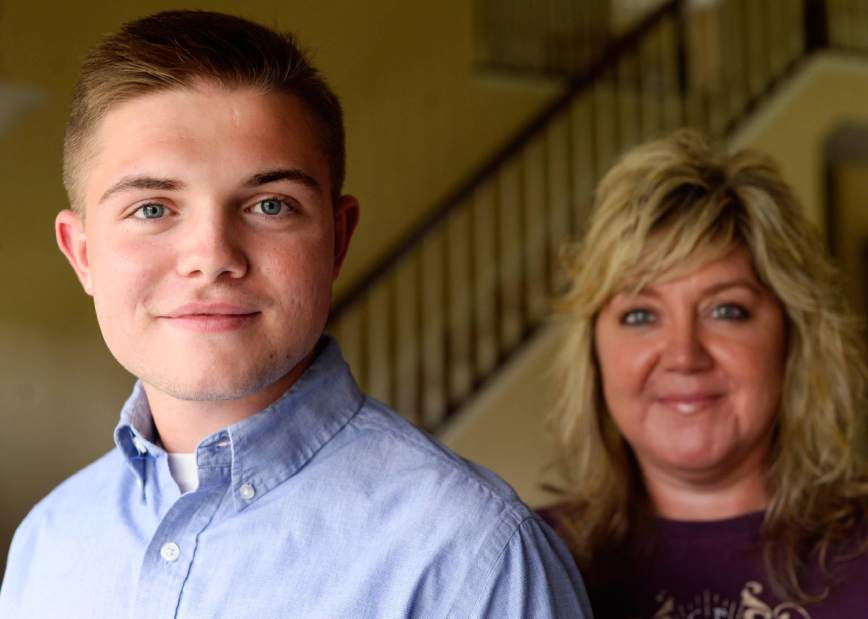
DOVER — Griffin Sneath was a third-grader at Weigelstown Elementary when he and classmates sometimes argued about evolution.
It was about a year since a federal judge ruled that the Dover school district's mention of intelligent design as an alternative to Darwin's theory injected religion into science class.
My parents told me I didn't come from a monkey, Griffin's classmates would say.
Actually, Griffin would reply, you did.
In October 2004, the Dover Area School Board in York County, citing a need to make students “aware of gaps/problems” in Darwin's theory of evolution, voted to add the mention of intelligent design to the ninth-grade biology curriculum. Intelligent design is the idea that life is so complex it must have required an “intelligent designer” to begin.
The ACLU of Pennsylvania and other groups sued on behalf of 11 parents, including Griffin's mother. Intelligent design, they said, was creationism in disguise.
The lawsuit led to a trial that started 10 years ago this month in federal court. The case resonated across the United States and the world.
Some called it the second Scopes Monkey Trial. “The Daily Show” with Jon Stewart visited Dover to do a series called “Evolution Schmevolution.” Darwin's great-great grandson, Matthew Chapman, stopped by and eventually wrote a book about the controversy. PBS made a documentary about the case.
The judge wrote that intelligent design could not separate itself from its religious origins, and mentioning it in a public school science class was unconstitutional. He noted that the people of Dover were poorly served by the school board members who voted for the policy. The district ended up paying $1 million in legal fees.
But before ruling, on Nov. 4, 2005, the judge listened to closing arguments. Eric Rothschild, an attorney for the plaintiffs, brought the case back to someone he had met as the lawsuit unfolded.
He talked about Griffin Sneath. It was students like him, Rothschild thought, who brought home why the case mattered. Even at 7, Griffin's interest in science had started to take hold.
Griffin, Rothschild said, could “become anything right now.” He could be a science teacher in Dover or somewhere else, “turning students on to the wonders of the natural world and the satisfaction of scientific discovery.” Or, perhaps, he could be a renowned college professor — like many of the experts who testified for their side in the case.
“He might solve mysteries about the immune system because he refused to quit. He might even figure out something that changes the whole world,” Rothschild said, “like Charles Darwin.”
Every day, as part of Griffin's grade-school routine, he would wake up and go to his parents' room to say good morning.
But in the fall of 2005, his parents were getting up way earlier.
They were putting on “fancy clothes,” Griffin recalled, and driving to Harrisburg to go to court. Everybody was talking about a lawsuit.
“My mom's doing something really cool,” he remembers thinking. “I don't know what it is. But she's doing something really cool.”
One day in October, his mother, Cyndi Sneath, took the stand.
“Do you have a personal interest in science?” asked Vic Walczak, the legal director of the ACLU of Pennsylvania and one of the plaintiffs' attorneys.
“Not personally, no,” Cyndi Sneath said. “You know, I have an interest for my son, who actually shows a great interest in science.
Not long after the decision, during indoor recess, one of Griffin's third-grade classmates asked him: “If I came from monkeys, why are there still monkeys?”
Griffin went to the chalkboard. He drew an upside-down “v,” and then tried to explain the concept of the common ancestor — in elementary school terms.
“We're down here, and here's the monkeys,” he said, showing them the two separate paths. “And we evolved separately.”
In his ninth-grade civics class, they were starting to learn about the ACLU. Many students might not have known much about the organization before taking the class, he thought.
Then it hit him:
“Everything we went through wasn't necessarily normal for most people.”
Today at Central York High School, Griffin is the president of the Model United Nations Club and plays trombone in marching band, among being involved in other activities.
He's part of Science Olympiad, a competition in which students participate in events about science. On April 25 at Juniata College, he took third place in the state in the cell biology event.
Last summer, he did an internship at the ACLU of Pennsylvania in Harrisburg.
Now 17, Griffin has just started his senior year of high school, and is thinking about his future. He's torn between trying to be a neurosurgeon or, because of his internship, a civil rights attorney.
But through the years, Griffin says, he has remembered the message the court heard 10 years ago:
He can become anything.
