

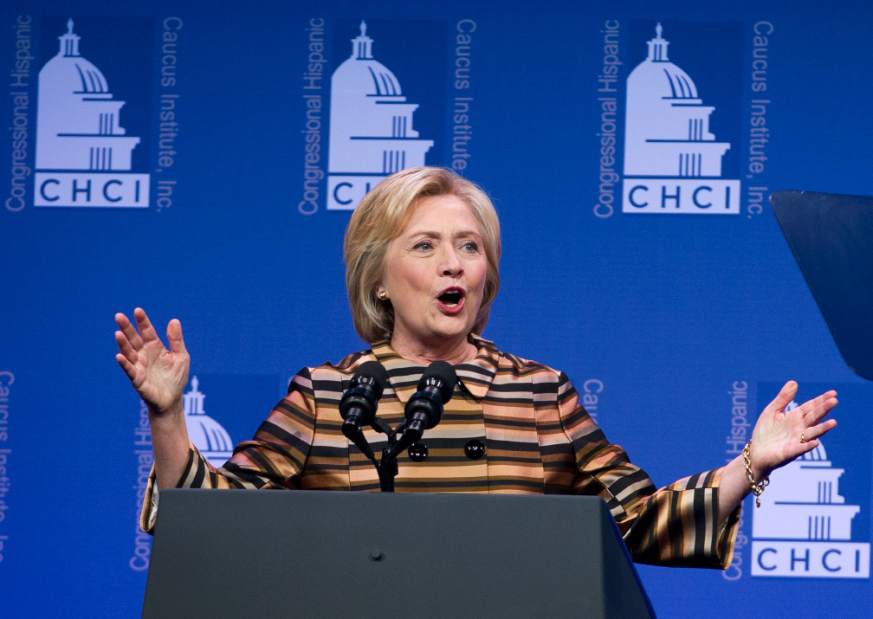
GREENSBORO, N.C. — Hillary Clinton returned to the campaign trail Thursday after three days of rest recommended by her doctor, giving an address on improving the welfare of children and families that is part of an effort by the Democratic candidate to refocus the presidential race on her credentials.
“I have to say, it's great to be back on the campaign trail,” Clinton said, after coming out to James Brown's “I Got You (I Feel Good).”
“I recently had a cold that turned out to be pneumonia. I tried to power through it, but even I had to admit that maybe a few days' rest would be good,” she added. “I'm not great at taking it easy, even under normal circumstances, but with just two months to go until Election Day, sitting at home was just the last place I wanted to be.”
Clinton said that being off the trail gave her time to reflect on the core issues that brought her into public service in the first place. She noted that many families aren't able to take paid time off in the event of sickness.
“Life events like these are catastrophic for some families, but mere bumps in the road for others,” Clinton said, speaking at the University of North Carolina at Greensboro. “I have met so many people living on a razor's edge — one illness away from losing their job; one paycheck away from losing their home.”
“And that goes against everything we stand for as Americans,” she added.
Clinton's speech was part of a larger effort to refocus the presidential race on her credentials as well as to show voters a more human portrait of a candidate who can seem remote and programmed.
Younger voters, a problem for Clinton since the start of her campaign, are a particular target of the message now. Part of her outreach is an appeal to young people's idealism and sense of civic engagement, which Clinton's campaign hopes will translate to higher turnout than polls suggest.
“I want to give Americans something to vote for, not just against,” Clinton later told reporters traveling with her. “We are offering ideas, not insults,” she said. “Plans that will make a difference in people's lives.”
Clinton's campaign chairman, John Podesta, said the candidate and her aides expected the contest to be close.
“We always expected the race to tighten up; we still feel like we're in a strong position with organizational advantage in Florida and Ohio,” Podesta said. “They call these states battlegrounds for a reason.”
In a speech at the New York Economic Club, Donald Trump stuck to his script, avoiding the more improvisational style that has produced a cornucopia of controversies.
Trump scaled back his grandiose plan for tax cuts while proposing more benefits for lower-income households in a speech Thursday.
In his most detailed economic plan to date, the Republican presidential nominee essentially halved the amount of tax cuts he will seek to $4.4 billion over 10 years, in part by capping deductions. At the same time, Trump said his economic strategy — which includes overhauling government regulations, trade and energy policies — would boost economic growth to 3.5 percent a year on average, up from 2 percent in recent years. He promised that his plan would create as many as 25 million jobs over the next decade.
“This is the most pro-growth, pro-jobs, pro-family plan put forth perhaps in the history of our country,” he said.
While responding to critics that his previous tax and growth plans were vague and unrealistic, Trump nonetheless raised questions about how he could achieve such rapid economic growth — former candidate Jeb Bush was derided for promising 4 percent growth — and pay for what are still very large tax cuts to individuals and businesses.
“It's still very pie-in-the-sky,” said Marc Goldwein, senior vice president for the Committee for a Responsible Federal Budget, a nonpartisan group that advocates keeping government budgets under control.
Trump's plan would reduce the tax brackets for individual income tax to three from the current seven, with the highest rate dropping to 33 percent from 39.6 percent. Deductions would be limited at $100,000 for single filers and $200,000 for married filers, which would restrain high-income filers looking to deduct more for housing and charitable donations.
In attempting to appeal to lower- and middle-income Americans, Trump called for an expanded earned income tax credit and tax savings for childcare expenses.
In addition, it appeared that sole proprietorships, partners and other so-called pass-through entities, which tend to be used by higher-income filers, would not be able to take advantage of Trump's plan to lower the corporate tax rate to 15 percent from the current 35 percent, said Howard Gleckman, a senior fellow at the Tax Policy Center.
