

For Eric Deihl of Hunker, a chemistry major at the University of Pittsburgh at Greensburg campus, the abandoned mine drainage treatment system in Lowber is the perfect place to conduct the research on the impact of acidic mine water on plants for his senior capstone project.
“I've driven by this (settling ponds) and never knew what it was,” said Deihl, who plans to irrigate sunflowers, tomatoes and lettuce he will grow this summer with water from the mine drainage treatment system.
Deihl said he plans to use water that has almost completed its 90-hour trip through the treatment system. By that time, the water has lost much of the orange-colored iron oxide that drops to the bottom of the settling ponds. After harvesting the plants that he will grow atop a levee, he will use acids to break down the plants so he can test the effect of the mine water on those plants.
The Sewickley Creek Water Association's $1.3 million mine drainage treatment system that was built along Lowber Road in Sewickley Township in 2006, has become an educational site as well as a place where water pouring out of the flooded Marchand mine is treated before flowing into nearby Sewickley Creek.
“We wanted to get several universities involved in our project. Our ultimate goal is that we want the college students working side-by-side with the high school students,” in the region, said Thomas Keller, executive director of the watershed association, a Youngwood-based nonprofit.
The association has formed partnerships with the chemistry and biology departments at Pitt-Greensburg and California University of Pennsylvania, which has allowed for faculty and student scientific research projects.
The site affords the Pitt-Greensburg students the opportunity to do experiential learning, said Sharon P. Smith, president of Pitt-Greensburg.
“It's real learning ... not just in the classroom. It's actually doing it,” Smith said.
The watershed association sees the value of opening the Lowber site to area schools and colleges as an outdoor laboratory where students can learn about the effects of water pollution, as well as the plants and animals supported by the environment of the treatment system.
Students conducting research at the site will get to see how water flowing out of the flooded former Marchand mine at a rate of about 1,800 gallons per minute, turns orange from the iron oxide created when the mineral comes in contact with oxygen. Using gravity flow without any pumps, water moves through a series of settling ponds. Most of the orange-colored iron oxide drops to the bottom of the first of six settling ponds before moving through a constructed wetland, Keller said. The water is clean enough to allow for trout stocking in Sewickley Creek, which meets the Youghiogheny River at Gratztown.
For the past few years, several students from the Pitt-Greensburg campus have been conducting water quality research at the site, as well as upstream and downstream of the treatment system, to determine the efficiency of the treatment system and the overall quality of the stream, said Larry D. Myers of Hempfield, the watershed association's treasurer.
Mark Stauffer, associate professor of chemistry at Pitt-Greensburg, has done research with his students at the site and is working with Deihl on his capstone project. Two other Pitt-Greensburg professors, Tim Savisky, assistant professor of biology and Dean Nelson, assistant professor of statistics, have worked with students to assemble water-related data for study and sharing, the association said.
Students from Cal U are scheduled to work this summer with Robert Whyte, professor and chairman of Cal U's biology and environmental sciences department, on his floristic assessment of the plants that are growing around the treatment site. The study will look at what plants should be in that area and which plants are invasive, Whyte said.
“You want it as natural as possible. You want to have a good functioning system,” Whyte said.
Cal U students have worked at the watershed association's mine drainage treatment site at Brinkerton in Hempfield, Whyte said.
The association said that the Cal U students will conduct a comprehensive survey of the vegetation along the Brinkerton levees. The students will take into account the species, their abundance and location and use global positioning and geographic mapping systems to produce a map of the plants. The goal is to document any problem area where the plants might interfere with the integrity of the levees, the association said.
To accommodate the students who will be studying and conducting research at the mine drainage treatment site, the watershed association wants to build a 20-foot-by-40-foot pavilion so the students can have a shelter when they conduct their experiments and use their computers, Keller said.
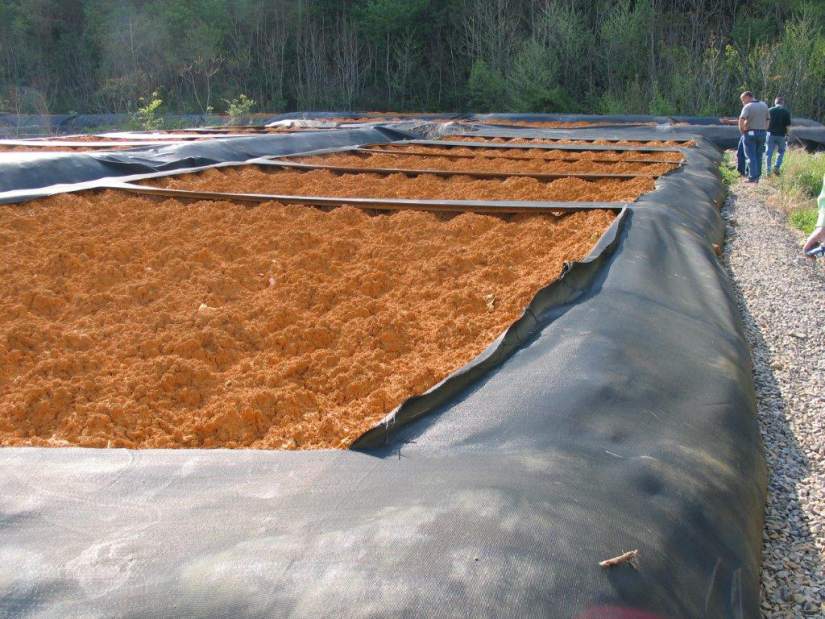
The association is attempting to make the Lowber mine drainage treatment system self-sufficient by selling the orangish iron oxide to a pigment company, said Robert S. Hedin, president of Iron Oxide Recovery Inc. of Mt. Lebanon, who serves as a consultant to the association and helped to design the treatment system.
“This (closed mine) will make iron oxide longer than any of our lives will last,” Hedin said as he stood atop one of about 10 black filter fabric containing tons of iron oxide.
The association sold about 700 tons of the iron oxide prior to the recession, but only about 300 tons of the 1,000 tons the mine has produced in the intervening years, Hedin said.
“We need to sell a lot more,” Hedin said.
Joe Napsha is a staff writer for Trib Total Media. He can be reached at jnapsha@tribweb.com or 724-836-5252.
