

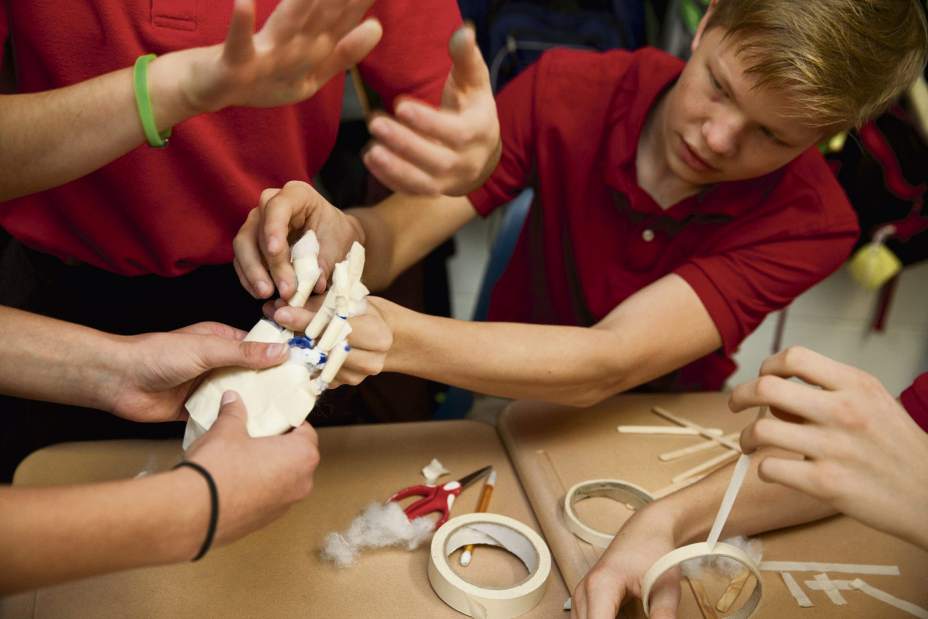


Eighth-grade students at St. Sebastian School in Ross recently took on a seven-week-long science project: designing a prosthetic left hand for a theoretical soldier who lost a limb in battle.
Using cardboard, cotton, glue, and other household items, the 37 students broke into teams to design and build a prosthetic hand prototype that can bend, move its fingers, and disguise the fact that a real hand is missing.
“It was a lot harder than we thought,” said Michael Taft, 14, of McCandless.
“Our original idea was to attach a watch to the prosthetic wrist. A dial on the watch would control strings that could move the prosthetic fingers.”
The idea, however, quickly was scrapped because of its complexity.
“We aimed a bit too high,” said Nick Weising, 14, of Shaler.
The team's new design features a wooden palm with duct-tape fingers and pipe-cleaner joints that can bend readily.
“I liked intertwining the different materials. I never thought wood and popsicle sticks could make a hand,” said Matthew Marchese, 14, of West View.
The STEM class, which combines science, technology, engineering and mathematics — or STEM — into hands-on projects, is held once a week as a supplement to the students' daily physics class. Both are led by science teacher Bryan Annis, 31, of Shaler.
“This is the first year for the STEM class, and this is the first project of the year,” he said, noting that as the year progresses, so will the complexity of the projects.
“The class is adding a new dimension to our science curriculum. It's all design-engineering projects. Students will design projects to solve specific problems.”
His ultimate goal is to make science fun.
It seems to be working.
Students were enthusiastically sharing ideas among their teammates, and occasional bursts of laughter rose above the chatter as they worked to bring those ideas to life.
“We've had arguments,” admitted Carlie Kreutzer, 13, of McCandless. “But we know not to get too mad at each other.”
Each team consists of students fulfilling a specific role, like mechanical engineer, bio-medical engineer, electrical engineer, product developer or industrial designer.
“They had to research what their particular role is responsible for, then present it to the class. Then they had to work together to develop an idea and create the design,” Annis said.
“We came up with a bunch of ideas, then knocked off the bad ones. It was an interesting process to see how you can make a hand without it being some mechanical, robotic hand. It can be as simple as popsicle sticks and tape,” said Xavier Moskala, 13, of Ross, who was the industrial designer on his team.
Kate Wells was the lead engineer for her team's project and wanted to make her team's prosthetic hand as life-like as possible.
“We used duct tape to give it the feel of skin. We used cotton for stuffing to give it shape, just like the tissue and fat of a real hand,” said Wells, 13, of Ross.
She added that she enjoys the new STEM class.
“In science, we learn about things by reading the book, but projects like this allow us to do things so we understand how things actually work.”
Laurie Rees is a contributing writer for Trib Total Media.
