

For gardeners who grow sweet corn, there's no more dreaded pest than the corn earworm. After waiting weeks for the corn harvest to mature, it's a real disappointment to peel back the outer husks of an ear of corn and discover a chubby brown caterpillar munching away on the kernels.
Like any other garden pest, the first step in tackling corn earworms is to understand their lifecycle. While managing this pest with chemicals is standard practice on big farms, most home gardeners will want to stay away from these synthetic products to limit their exposure as much as possible.
The corn earworm, Heliothis zea, is actually not a worm at all, but rather a caterpillar. The larvae of a dark brown or olive green, night-flying moth, earworms can reach an inch in length just before they pupate into adults. Earworms are often brown or dark green with a yellow or black stripe down their side. When you peel back the husk of the corn, the caterpillar is often found curled into a C-shape at the base of the silks.
The same species of caterpillar also feeds on tomatoes, where the caterpillar is called a tomato fruit worm. Tomato damage appears as perfectly round holes drilled straight through the flesh of ripe tomatoes.
In the corn patch, not only do the maturing earworms feed on the corn kernels themselves, but as the cob is growing, the young caterpillars may also feed on the leaves and tassels of the plant, causing different layers of damage. We gardeners, however, tend to notice this pest the most, of course, when we crack open an ear of corn and discover them hidden inside.
There are several different ways to control corn earworms without using synthetic chemical pesticides. First, closing the top of the developing ear as soon as the silk starts to develop can keep young caterpillars out of the ear completely. If your corn patch is fairly small, use a wooden clothespin or a piece of clear packing tape to pinch the top of the husks together securely. The female moth can still lay her eggs on the silks as usual, but the young caterpillars won't be able to crawl down into the cob and begin to feed.
Another option is to apply five drops of corn oil laced with the natural biological insecticide Bacillus thuringiensis (Bt) to the tip of each developing ear. This is best done when the silk begins to brown. Use 3 tablespoons of Bt per quart of the mixed oil. It might seem like a pain to apply the Bt and oil combo, but for home gardeners with a small to moderate sized corn patch, it doesn't take long, if you have a medicine dropper or needle-less syringe to apply the Bt-oil mixture. I've also applied it via a squirt gun and it worked like a charm. Just shoot five drops out of the gun down into the tip of each ear.
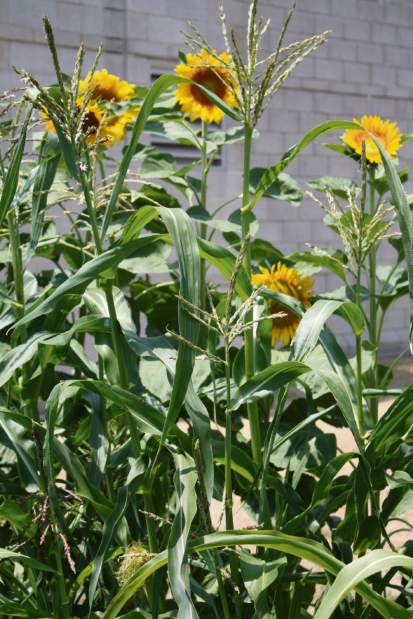
A third way to send corn earworms packing is to encourage the multitude of beneficial insects that use corn earworm caterpillars as food or as hosts for their developing young. Farms and gardens with corn patches that are inter-planted with lots of flowering herbs and annuals have higher numbers of the predaceous and parasitic insects that naturally help reduce corn earworm numbers. Good flowering plant choices to include in and around your corn plants include dill, fennel, sunflowers, cosmos, cilantro, Ammi and lots of others. Several studies have shown that the presence of beneficial insects such as spiders, minute pirate bugs, parasitic wasps and tachnid flies can reduce corn earworm numbers by as much as 70 percent.
And finally, you can also choose to do nothing to manage the corn earworms in your corn patch. The good news is that even when present, these caterpillars don't cause significant damage to ripe ears. They tend to stay close to the tips of the ears as they feed, and while discovering them in an ear of homegrown corn is kind of icky, their damage is very easy to cut out of the cob. The rest of the undamaged corn is perfectly edible.
Horticulturist Jessica Walliser co-hosts “The Organic Gardeners” at 7 a.m. Sundays on KDKA Radio with Doug Oster. She is the author of several gardening books, including “Attracting Beneficial Bugs to Your Garden: A Natural Approach to Pest Control” and “Good Bug, Bad Bug.” Her website is jessicawalliser.com.
Send your gardening or landscaping questions to tribliving@tribweb.com or The Good Earth, 622 Cabin Hill Drive, Greensburg, PA 15601.
