

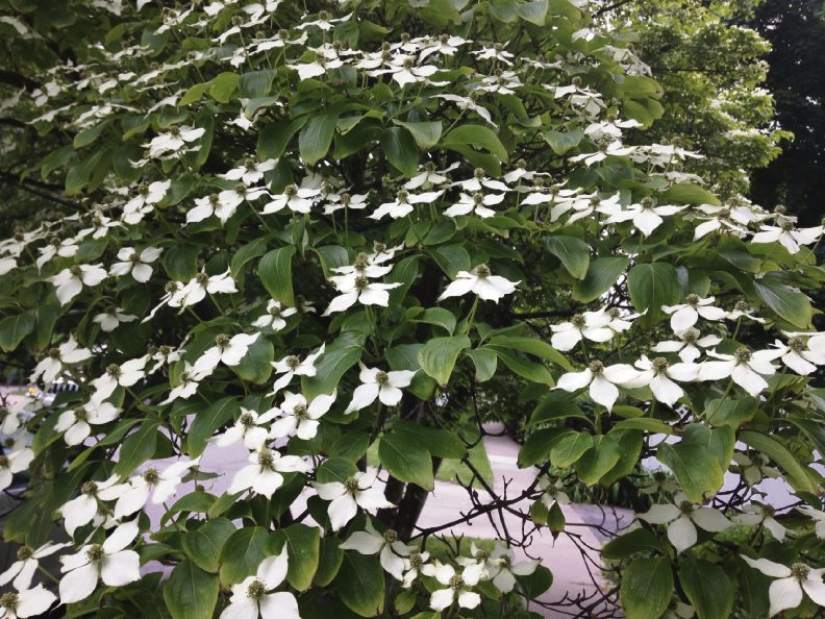
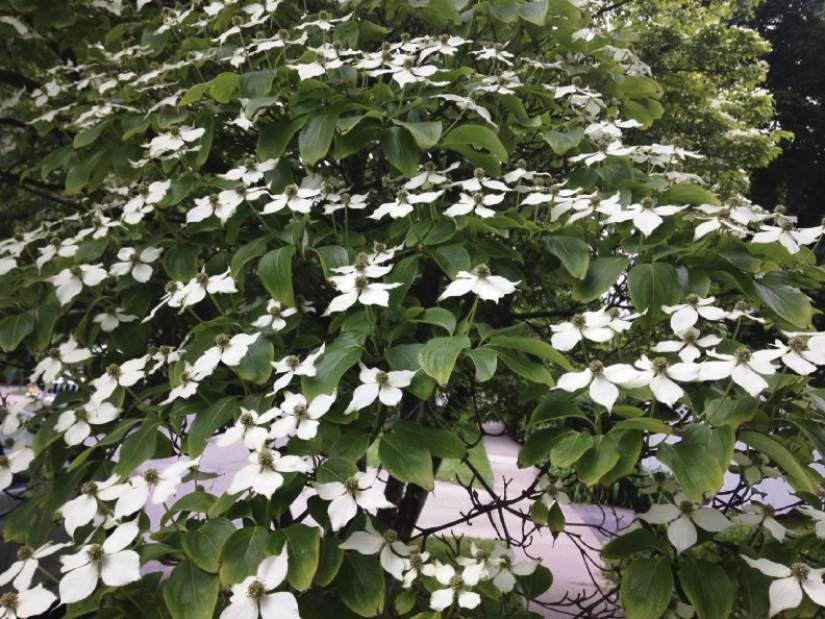
Question: We have a Kousa dogwood that is 23 years old. It has bloomed only three times (the first time was when it was 18 years old). It bloomed this year but not last year. Do you have any suggestions to get it to bloom every year? It gets mostly full sun, but there is a bit of shade in the late afternoon. I was so excited to plant it because of how beautiful they are when in bloom.
Answer: Kousa dogwoods ( Cornus kousa) are lovely small trees. They're native to parts of Asia and reach only 30 feet in height at maturity. One of the most noticeable ways they differ from our native dogwood ( Cornus florida) is in their flowering habits.
Unlike native dogwoods, whose flowers open well before the leaves emerge, the blooms of Kousa dogwoods open only after the tree is in full leaf. Most commonly, Kousa dogwood flowers are white, though a few pink cultivars exist. After the blooms fade, they're followed by highly ornamental, raspberrylike red fruits. While edible to humans, most folks just let the birds snack on the berries.
Their vase-shaped growth habit makes this species an excellent selection for home landscapes. Kousa dogwoods are considered by many to be more disease-resistant than native dogwoods, and they are more tolerant of full-sun conditions. Native dogwoods far prefer conditions with dappled shade or a site on a woodland's edge.
Newer Kousa cultivars usually flower every year, without the need for any special care — it's one of the reasons for their popularity. But, if you're tree is the straight species, and not a cultivar, it may be a bit more temperamental about blooming.
It's important to know that both native and Kousa dogwoods form their buds on old wood, meaning next spring's flowers are formed the autumn before. If you prune dogwoods either in the fall or in the early spring, before they bloom, you're cutting off the flower buds. The best pruning technique for dogwoods is to not prune them at all. Pruning cuts can introduce disease organisms, and in the case of a dogwood, the tree's lovely natural shape seldom calls for any pruning.
If you must prune your dogwood, prune it immediately after it flowers in the spring. This will give the tree ample time to produce new growth and flower buds for the following year.
If you aren't pruning your tree inappropriately, there may be something else going on. Kousas generally take between eight and 10 years to produce their first blooms, with some cultivars flowering before others, but because your tree is already old enough to regularly flower, age is probably not an issue.
Outside of proper pruning and understanding the nature of this particular plant, here are a few other tips to encourage your tree to flower.
• Avoid using high-nitrogen fertilizers (including lawn fertilizers) around your dogwood. Excessive nitrogen can cause the tree to develop more leaves at the expense of flowers.
• Mulch the tree with a 2- to 3-inch layer of shredded bark mulch every spring, being sure to keep it a few inches away from the base of the trunk (shape your mulch like a doughnut around the tree and do not apply too thickly).
• Because dogwoods have a fairly shallow root system, stress from summer and fall droughts also can prevent bud formation. Be sure to irrigate your tree during prolonged dry periods, especially when the buds are forming.
Horticulturist Jessica Walliser co-hosts “The Organic Gardeners” at 7 a.m. Sundays on KDKA Radio with Doug Oster. She is the author of several gardening books, including “Attracting Beneficial Bugs to Your Garden: A Natural Approach to Pest Control” and “Good Bug, Bad Bug.” Her website is jessicawalliser.com.
Send your gardening or landscaping questions to tribliving@tribweb.com or The Good Earth, 503 Martindale St., Third Floor, D.L. Clark Building, Pittsburgh, PA 15212.
