
Western Pa. turkey farmers give thanks as their work reaches the table

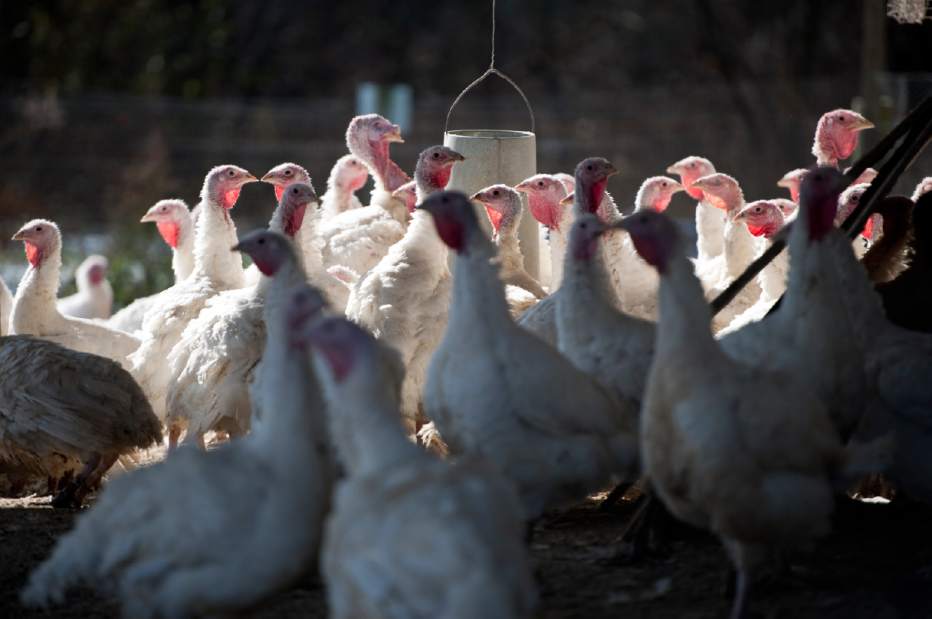

Butler County turkey farm owner Dave Jones doesn't get a lot of rest the week before Thanksgiving.
“I almost dread the week before Thanksgiving because there will be no sleep. I'll lay down, but I won't sleep. You have to make sure you have everything just right,” said Jones, 58, of Cabot and owner of Jones Turkey Farm. “I love to help feed America. There's no better feeling than the week after Thanksgiving when people call or write me a note, saying, ‘Mr. Jones, your turkey was wonderful.' ”
Jones is among a few Butler County and northern Allegheny County farms that raise turkeys that will appear on Thanksgiving dinner tables across the region.
Lydia Johnson, director of the bureau of food safety and laboratory for the Pennsylvania Department of Agriculture, said that typically farms with more than 1,000 turkeys are inspected by the U.S. Department of Agriculture and farms with fewer than 1,000 turkeys are inspected by the state.
Johnson said inspectors check for a variety of things in the slaughter area and the processing area, including proper sanitation and labeling.
“But once you get that turkey home, and we go through all of this, and they sit the turkey on the counter for six or seven hours -— that can cause illness,” Johnson said.
Jones, who grows his feed, raises and dresses about 3,500 turkeys yearly — about 3,000 for Thanksgiving and 500 for Christmas. Prices range from $2.50 per pound for recently frozen birds to $2.99 per pound for birds never frozen. He sells 500 to 600 nonfrozen turkeys in the days before Thanksgiving.
The weekend before Thanksgiving usually is the end for most farmed turkeys — at least the ones that won't be frozen. The birds typically are 14 to 20 weeks old at slaughter, although some farmers, like Jones, can farm them longer. Farms typically get their turkeys from hatcheries when they're a day old in mid-summer.
“It's usually the weekend before (Thanksgiving) that we dress them, get them iced down and put them in the coolers,” said Reed Soergel, 57, of Evans City, part owner of Soergel Orchards in Wexford.
Soergel's turkey farm in Evans City is a smaller operation, raising about 200 turkeys each year. He feeds the birds homegrown corn mixed with soybean meal. The fresh birds go for $3.59 per pound to his customers.
“When you can get that fresh bird, people say it's better. It doesn't take as long to cook. People like that fresh turkey,” Soergel said.
Phillip Clauer, a senior instructor and poultry specialist at Penn State University, said that's not just a myth.
“A fresh-dressed bird that has not ever been frozen is much more juicy, which most people equate to taste,” Clauer said. “When you freeze it, there's a change in the tissues and it will be a little dryer.”
Nonfrozen turkeys should be eaten within seven days, he said.
Ron Eichner, owner of Eichner's Farm in McCandless, prepares 575 to 585 turkeys for Thanksgiving and about 170 for Christmas. His birds eat 650 pounds of homegrown feed per day, or the equivalent of 21 5-gallon buckets.
“I get up to the pens several times a day. You want them to be content,” Eichner, 55, of McCandless said. “I took over for my uncle in 2001. That first year, I was losing turkeys every which way.”
Eichner, whose birds go for $3.69 per pound, since has learned to raise them as well as the previous generations of his family. His farm also raises chickens and sells fresh eggs year round in addition to pork products and vegetables.
The weekend before Thanksgiving, though, calls for extra help.
“We have friends and family come in the weekend before Thanksgiving to help. The Friday and Saturday before, we dress them; Sunday we bag and weigh them, and they're ready for pickup Tuesday and Wednesday,” Eichner said. “People have gotten away from self-sufficiency so much that some people are like, ‘Oh, I could never do that.' It's a very humane process.”
Bobby Kerlik is a staff writer for Trib Total Media. He can be reached at 412-320-7886 or bkerlik@tribweb.com.
