

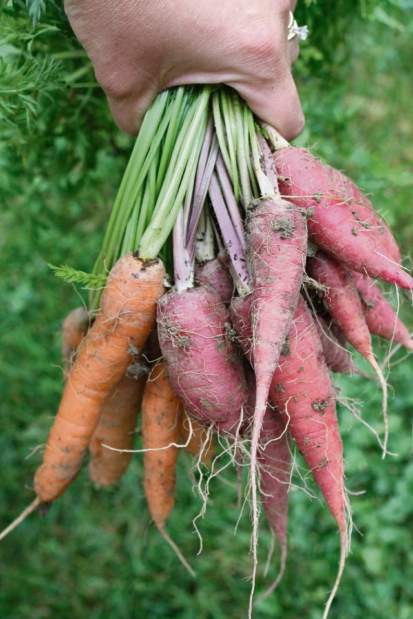
Question: I'm going to be growing some vegetables in containers for the first time this year. I'm going to plant tomatoes, peppers and eggplants in 5-gallon containers, as well as some cabbage and broccoli. I'm wondering, though, can I grow carrots in containers? If so, is there anything special I need to do? Any advice would be appreciated.
Answer: You're in luck! Growing carrots in containers couldn't be easier. There's no need to invest in nursery-grown transplants or to start seeds indoors, and you won't have to worry about weeding or deep tilling or any of the other tasks gardeners have to think about when they grow carrots in the ground.
To begin, select the right variety of carrots. While nearly any type of carrot will grow in containers, longer varieties will need very deep, straight-sided pots. If you don't want to have to think too hard about the type of container you're growing them in, consider planting round, squat carrot varieties such as ‘Romeo,' ‘Parmex' and ‘Paris Market.'
Next, pick your container. Carrots do best in glazed ceramic, plastic or fabric pots; unglazed terra cotta pots dry out too quickly. You can use just about anything for a container, including old buckets, tubs and bins, as long as it will hold soil and there's a drainage hole in the bottom.
Plan on growing about five carrots for every one gallon of potting soil the container holds. A 5-gallon bucket can house about 25 carrots, while a 1-gallon nursery pot can accommodate only five.
Fill the container with a 50/50 mixture of high quality potting soil and compost. Both can be purchased by the bag from your local garden center. Don't skimp and buy the cheapest potting soil you can find; as with most things in life, you get what you pay for. Good potting soil makes all the difference when growing vegetables in containers.
After the container has been filled, sow the carrot seeds, spacing them 1 to 2 inches apart to give them enough room to grow and to avoid having to thin the seedlings out later. Cover the seeds with a quarter-inch of potting soil and water them.
Here in Western Pennsylvania, carrot seeds can be planted any time between late March and early July. In order to have a continual harvest, consider planting a new container of carrot seeds every few weeks throughout the summer.
Keep the pot well-watered, especially before germination and while the seedlings are still young. Carrots take a long time to germinate, sometimes two or three weeks.
During hot summer weather, you'll need to water your containers every day to ensure good root formation. If you want, you can mix an organic, liquid fertilizer, such as liquid seaweed or fish emulsion, in with the irrigation water once or twice a month according to label instructions.
Your carrots will be ready to harvest about 65 to 80 days after planting. To harvest, simply pull the carrots out of the container, shake off the soil, wash the roots and enjoy.
Horticulturist Jessica Walliser co-hosts “The Organic Gardeners” at 7 a.m. Sundays on KDKA Radio with Doug Oster. She is the author of several gardening books, including “Attracting Beneficial Bugs to Your Garden: A Natural Approach to Pest Control” and “Good Bug, Bad Bug.” Her website is jessicawalliser.com.
Send your gardening or landscaping questions to tribliving@tribweb.com or The Good Earth, 503 Martindale St., Third Floor, Pittsburgh, PA 15212.
