



Math — it's just plain ... sexy?
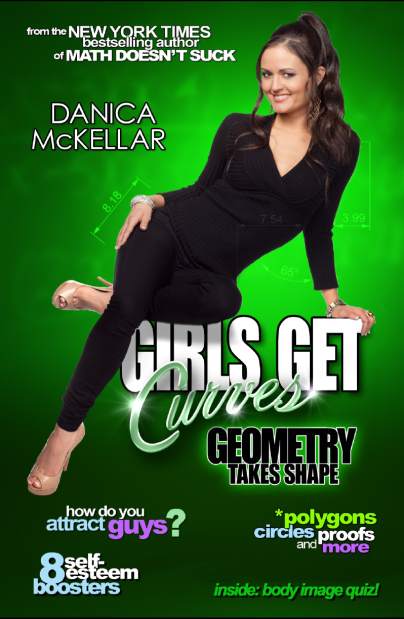
Most of us remember Danica McKellar as Winnie Cooper on the popular series “The Wonder Years,” but as of late, middle schoolers are getting to know the certified math genius as the New York Times best-selling author of “Kiss My Math: Showing Pre-Algebra Who's Boss,” “Math Doesn't Suck: How to Survive Middle School Math Without Losing Your Mind or Breaking a Nail,” “Hot X: Algebra Exposed!” and her latest, “Girls Get Curves: Geometry Takes Shape.”
Her feisty series debunks the myth that mathematics is a man's sport, taking an unorthodox approach to equations by explaining the basic principles of mathematics using very real sociological issues that every young woman faces today. Peppered in between each lesson are testimonials from reformed math haters both young and old, entertaining personality quizzes a la Teen Vogue or CosmoGIRL! and stories about her personal experiences. More than just a study guide for improving a girl's GPA, these books are meant to empower a new generation of strong, smart, and sassy young ladies to believe in themselves and to never shy away from a challenge.
Question: You've managed to make a stodgy subject sexy — what made you want to shatter the “math nerd” stereotype?
Answer: I encountered it so often after I started as a math major at UCLA, and people would say, “Wait – you're an actress. Why do you want to be a math major?” And I thought why not?! It was sort of a long process — I didn't start writing the book back then. I started to write a blog about math and relationships, and in 2000, to reach out to middle-school girls and show them that math is for them, and it can help them be a fabulous young woman. And that you don't have to choose being the fun, fabulous, popular girl and being the smart nerd. Don't let people pigeonhole you.
Q: Your books have some pretty sassy titles — was the initial reaction positive or were there some people who were put off by them?
A: For sure, there were some administrators who didn't like the word “suck” in the title “Math Doesn't Suck.” And they said they don't even allow kids to wear T-shirts with that word. And then I got emails from kids who said they were sneaking the book into school, and when I heard that I thought, I'm doing something right if kids are sneaking a math book into school! It's really some of the administrators ,and not the kids, who have a problem with the titles. But I'm looking to make math a little sexy and a little bit rebellious.
Q: How can understanding the concepts of math help improve a girl's self-esteem?
A: Getting good at something that's challenging is the key to good self-esteem. When you work at it and you overcome that challenge, you show yourself you're stronger and smarter than you thought you were, and you carry that to the next challenge. And, then, you get the attitude of “this looks really challenging, it's good I have me on my side.” And having that belief in yourself is so empowering. You can't just decide one day I'm going to feel good about myself. You build that; you build it by practicing something like math. Math is like going to the gym for your brain — it makes your brain stronger, you get better at logical and critical thinking and that serves you everywhere.
Q: When you get right down to it, you're in the business of empowerment. Was that your initial goal or did it just come about during the writing process?
A: It is something that happened in the middle of writing the first book. I sent out surveys to schools, and I sent (the students) questions about the perceptions — “What do you think about math?” and “What do you think it means to be a smart girl?” And when it came to “What do you think it means to be a dumb girl?” these 12-year-olds were writing back saying that they weren't dumb, they pretend to be dumb. They were literally dumbing themselves down.
Q: There's a tendency for people to play the blame game, yet you really encourage ownership and accountability in your books. Why were these values so important for you to include?
A: That's finding happiness within — not looking to others to blame or save ourselves. We live in a consumer society, and it's just what's going to happen. It's in a corporation's best interest to convince consumers they need something to make themselves happy. And that's just not true. They can look to themselves to be that rock – they can look to themselves to get that fulfillment.
Q: After reading the testimonials that you received from middle schoolers across the country, what's one message you'd like to impart to teachers and parents about girls today?
A: That they all have a smart, confident self locked inside them, and they need that encouragement. They need to be told that they are the ones who are going to be the strong, powerful force in their lives. Again, the opposite of the message we keep getting, which is looking outside ourselves for fulfillment. Because these girls write to me and say, “I finally get it! I finally feel confident!” And it's not because of one book – it was always there.
Q: Is there any type of math that even you loathe?
A: Well, any math that's never explained! Anything that remains confusing. Nobody likes something that makes them feel stupid. Math is a foreign language, and if it stays foreign, it's no fun.
Kate Benz is the social columnist for Trib Total Media. She can be reached at kbenz@tribweb.com or 412-380-8515.
