
https://archive.triblive.com/opinion/editorials/new-voting-machines-will-be-costly-but-necessary/
New voting machines will be costly, but necessary

• |
Dan Speicher | Tribune-Review
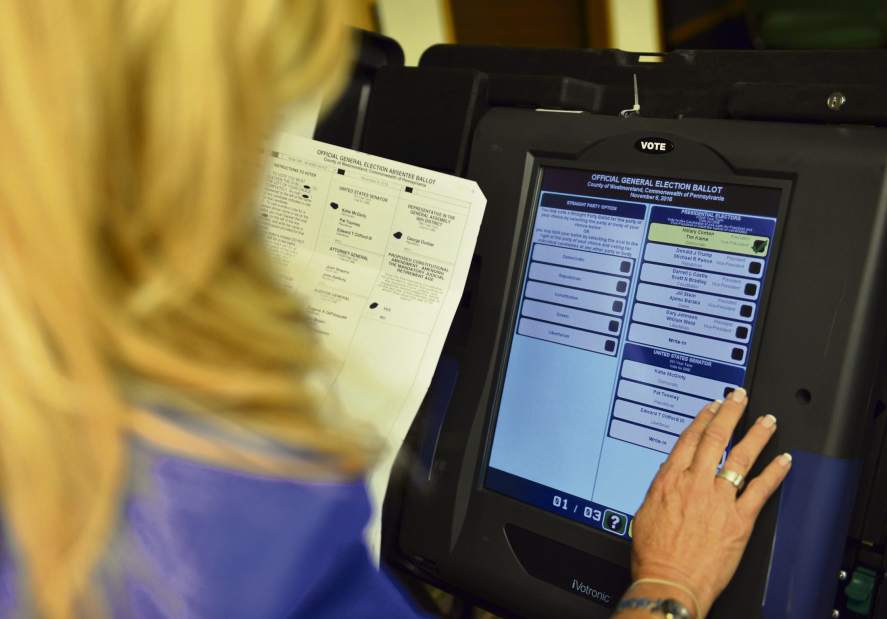
A Westmoreland County employee punches in the votes that she filled out on paper into a polling machine during a public test of voting equipment prior to the 2016 general election.
There’s no doubt there will be howls of discontent when Westmoreland County has to pay for new voting machines.
Especially seeing that about one in five eligible adults aren’t registered to vote, and it’s a big turnout when 60 percent of those registered voters show up on Election Day.
But it’s a move that,expensive or not, must be done. Ensuring fair elections is the cornerstone of American democracy — something that citizens of many parts of the world yearn for.
State election officials have ordered every county to start using voting machines that provide a verifiable paper trail of the votes cast by the 2020 elections.
In conjunction with that, a blue-ribbon commission has just been named to gauge the protection level of the state’s electronic voting machines, which co-leader David Hickton called “vulnerable.”
The proactive moves are in response to a report from the Department of Homeland Security, which found Pennsylvania was one of 21 states targeted by hackers during the 2016 elections.
Westmoreland’s current voting machines, computerized touchscreens bought in 2005, don’t allow for a paper trail.
The machines electronically record votes and stores the totals digitally. Absent printouts, there’s no way to double check the results.
The county’s decision to buy “direct-recording electronic voting machines” drew opposition at the time from VotePa, a grassroots group concerned with voting rights and election integrity.
But Westmoreland County officials can’t be faulted much for their decision. More than a decade before accusations of Russian election meddling surfaced, there was much debate about whether such verification was necessary. And some argued using paper ballots could invade privacy.
But more importantly, no voting machine that had paper backup had been certified for use in Pennsylvania at the time counties were switching from voting booths with levers to touchscreen ballots that make tabulation far faster.
In 2005, Westmoreland had the benefit of a $3 million federal grant to buy its machines, but the best it seems that the county can do this time is apply for up to $400,000 from the feds.
The state, at least at this point, isn’t ponying up anything, but the announcement of the election security commission suggests that may change.
The estimated price tag now is between $7 million and $8 million. If you took a vote on whether to buy the voting machines, it would likely go down in flames — assuming voters showed up to vote.
But Hickton is right: “Every part of our government and every part of what we stand for is premised upon free and fair elections and the public’s belief and confidence in our electoral system.”
It’s something that has to be done.
Copyright ©2026— Trib Total Media, LLC (TribLIVE.com)