
https://archive.triblive.com/opinion/featured-commentary/going-nowhere-fast-thats-not-necessarily-bad/
Going nowhere fast (& that’s not necessarily bad)

• |
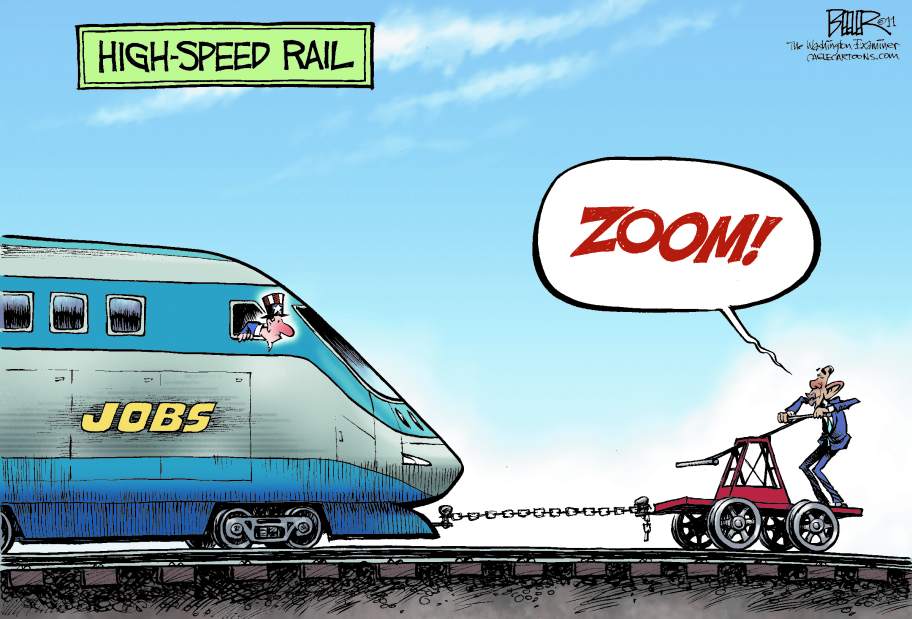
caglecartoons.com
Who is more powerful, the president of the United States or Michael P. Kenny of Sacramento?
Before you answer, consider this sequence of events: In April 2009, President Obama announced his “Vision for High Speed Rail” in America, backed by $8 billion in stimulus funds. The president pitched the plan in subsequent State of the Union addresses, signaling his commitment.
Fifty-five months later, on Nov. 25, 2013, Kenny, who happens to be a state judge, ruled that California could not sell billions of dollars worth of bonds earmarked for the San Francisco-to-Los Angeles portion of Obama’s plan. The state had no valid financial plan and state law requires one, Kenny decided.
Now the entire project, backed not only by Obama but also by Democrat California Gov. Jerry Brown, is in limbo. Construction might begin someday. But whenever that is, it will be long after the Great Recession, which high-speed rail was supposed to help relieve.
It’s another reality check for Obama’s high-speed-rail “vision” — and for the popular idea that government infrastructure projects can create jobs in the short run and enhance the economy’s capacity for growth in the long run.
As evidenced by the fact that a single state judge can thwart a multibillion-dollar project backed by the leader of the free world, what often slows government infrastructure plans is government itself — or, more precisely, the peculiar structure of American government.
The United States, with its semi-sovereign states, separation of powers and multiple “veto points,” especially litigation, was not designed for the swift approval and execution of big, national construction projects. Federally funded “internal improvements,” in fact, were the stuff of bitter legal and political conflict in the early republic.
Like the Republican governors of Wisconsin, Ohio and Florida who rejected Obama’s funding for high-speed rail in their states, antebellum foes of public works feared that they would waste taxpayer money and aggrandize the federal government.
Kenny’s ruling on the California rail plan was almost certainly correct. The Brown and Obama administrations never have plausibly explained where they would get the $68 billion needed to build the whole California system. Even if completed, high-speed rail would not enhance productivity. Rather, it would consume subsidies, as it does in other countries.
In 2009, Obama lauded high-speed rail in Europe and Asia, and declared: “There’s no reason why we can’t do this. This is America.” Actually, countries that have high-speed rail — China, Japan, France and Taiwan, for example — also tend to have much more centralized government than the United States.
In other words, one reason we don’t have national high-speed rail, and probably never will, is that this is America.
Charles Lane, former editor of The Atlantic magazine, is a Washington Post columnist.
Copyright ©2026— Trib Total Media, LLC (TribLIVE.com)