

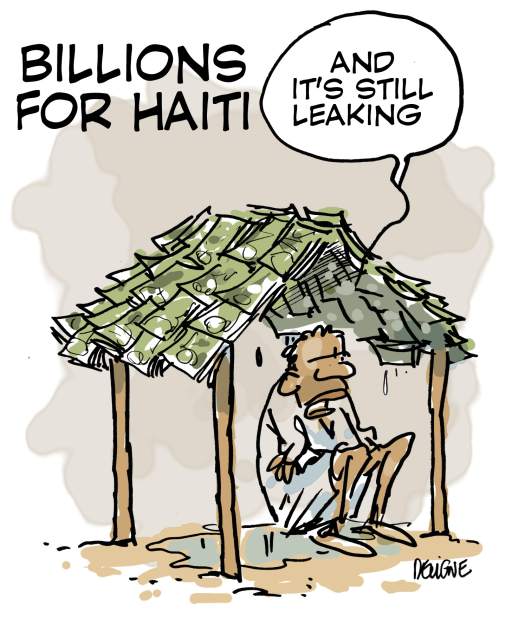
When Haiti was wrecked by a monster earthquake in 2010, many heartsick Americans reached for their checkbooks.
It's our national reflex after an international disaster. Seeing mass misery in a country so poor, we send money, hoping (and often assuming) it will be used to help those who need it most.
But the truth is, we don't know what happens after the check's in the mail. We pick a charity to trust and sometimes we pick wrong.
Following the catastrophe in Haiti, one high-profile relief organization raked in more donations than any other — the American Red Cross, which collected nearly half a billion dollars. It was a windfall for the group, which had been struggling to wipe out a $100-million-plus deficit.
Among other things, the Red Cross promised to develop new communities in Haiti for the many thousands left homeless by the quake.
Five years later, exactly six houses have been built. No new communities have been constructed.
The agency's efforts there have been scandalously sluggish, wasteful and inept, according to a disturbing report this month by National Public Radio and ProPublica, an online investigative news service. Unfortunately, it's not the first case of high-stakes bungling by the Red Cross. After Hurricane Katrina, volunteers reported widespread improprieties and chaotic record-keeping that resulted in the theft or “disappearance” of generators, air mattresses, rental cars and relief funds.
The Red Cross defends its work in Haiti, yet refuses to release a detailed account of where and how all the donated money — about $488 million — has been spent.
Among the agency's boggling and undocumented claims are that it provided housing for 130,000 people and helped “more than 4.5 million” Haitians “get back on their feet” — a highly improbable feat, considering that the estimated population of the whole country was only 9.8 million at the time.
A few months ago, in a rosy summary timed to the fifth anniversary of the earthquake, Red Cross CEO Gail McGovern wrote: “Millions of Haitians are safer, healthier, more resilient and better prepared for future disasters thanks to generous donations to the American Red Cross.”
Her assessment contrasts dramatically with the views of many Haitians and officials interviewed for the NPR/ProPublica investigation, which examined several ambitious-sounding Red Cross projects that fell apart.
In 2011, for example, the agency announced plans for a massive project to rebuild Campeche, an impoverished hillside neighborhood in Port-au-Prince that was pulverized by the quake. Seven hundred new homes were promised.
Four years later, nothing has happened. Residents of Campeche still live in tin shacks without safe drinking water, toilets or electricity. The only visible evidence of the Red Cross is a hand-painted logo on a wall.
One thing the Red Cross excels at is promoting itself, not only during a catastrophe but in the aftermath. While the Red Cross advertises that 91 cents of every donated dollar is spent on actual relief efforts, it ended up distributing much of its earthquake money to other charities. They took their own cuts for expenses and administration.
The next time a disaster strikes somewhere, don't feel anxious about reaching for your checkbook. It's still the right thing to do. Just be sure to pick a better charity than the American Red Cross.
Carl Hiaasen is a columnist for The Miami Herald.
