

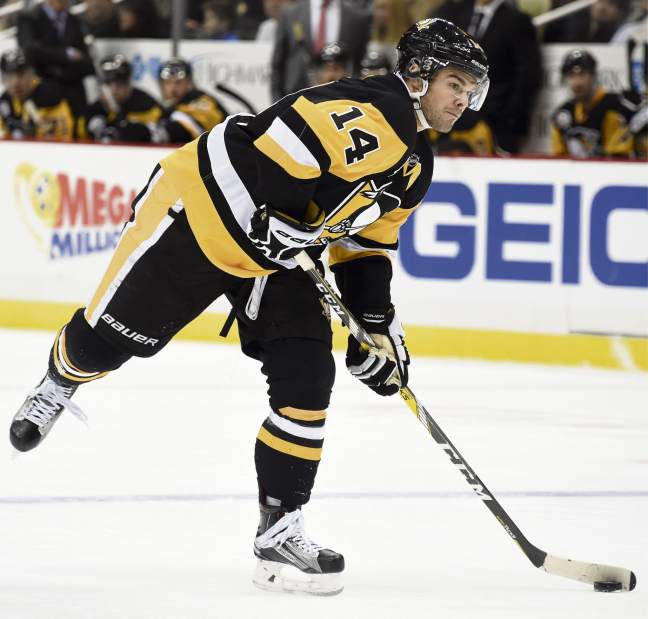



Chris Kunitz delivered the defensive highlight of the 2016 Stanley Cup Final for the Penguins when he chased down Joel Ward in the first period of Game 6, dove to his stomach and swatted the puck away from the San Jose forward to end a breakaway threat.
A different form of defense from the Penguins stuck out as oh-so critical in Kunitz's mind months later, though: penalty killing. The path to the Cup included successful kills on 11 of 12 man advantages for the Sharks, who proceeded through much of the 2016 postseason with a series-altering power play.
“It was really big in the playoffs last year,” Kunitz said. “We're trying to get back to that. But there's a lot of skilled teams out there with fast forwards and schemes that teams write up, so it's one of those things where you hope you can pressure them enough to get a bobbled puck or create a turnover so you shoot it down (the ice), get off and let someone else go out.”
For years, Kunitz commented on the Penguins penalty kill almost exclusively as an observer. He made his money as a top-line left winger and net-front presence on the power play. But adjustments made by coach Mike Sullivan and his staff during the past couple of weeks allowed Kunitz to at least briefly return to his penalty-killing roots.
Most notably, he logged 4 minutes, 30 seconds of short-handed ice time Sunday against Boston, his highest total since he killed 5:49 on Feb. 21, 2009 with Anaheim. The Bruins went 0 for 4 on the power play and became the Penguins' third straight opponent to fail to score with the man advantage.
“It's obviously an adjustment for your posture, trying to make sure you're in the right areas at the right times,” Kunitz said. “I've always done spot duty a little bit. With guys being out and moving down the lineup, responsibilities change, so I go out there and try affect things in a positive way. ... It's something that I'm definitely looking forward to the challenge of getting better at.”
Matt Cullen's broken foot, suffered Jan. 16 against Washington, left the Penguins without their most relied-upon penalty killer. Cullen leads a foursome of forwards — Nick Bonino, Eric Fehr and Carl Hagelin are the others — who average more than two minutes of short-handed ice time.
Kunitz's inclusion in the penalty kill actually preceded the Cullen injury, as Kunitz logged 1:44 of short-handed ice time against Ottawa on Jan. 12. His season high before that game was 26 seconds Dec. 3 against Detroit. But Cullen's ailment opened the door to more significant involvement for Kunitz, who has never averaged more than 31 seconds of short-handed ice time per game during a full season with the Penguins.
Almost all of his minutes at uneven strength during previous seasons went toward the power play. However, his average power-play time on ice sits at 1:34 this winter, the lowest mark of his career since his rookie season (1:11 in 2003-04). That affords him more energy for penalty killing.
Energy in the form of physicality and feistiness always has served Kunitz well, no matter his role in the lineup.
“The thing I like the most is just how heavy he is on the puck,” Fehr said. “He goes flying in with some reckless abandon, and it's really worked out for us. He gets there at the same time as somebody, and he's coming out with the puck and throwing it down the ice. Those 200-foot clears really make your penalty kill go.”
Shot-blocking, so often associated with penalty killing, has not been a habit for Kunitz, who tied for 18th among the Penguins with 12 through Monday. Bonino, Fehr and Tom Kuhnhackl embrace that tactic far more often. But Cullen and Hagelin, who have 15 and 16 blocks, respectively, offer examples of how to handle penalty kills without diving in front of pucks.
As Kunitz showed last spring with his backcheck against San Jose's Ward, the veteran winger recognizes when to get desperate on defense.
“He knows what it takes,” Hagelin said of Kunitz. “He works hard. He's fast. He's got a good stick and he's strong. He's a pain to play against, for sure.”
Staff writer Jonathan Bombulie contributed. Bill West is a Tribune-Review staff writer. Reach him at wwest@tribweb.com or via Twitter @BWest_Trib.
